Larger bench order THE HONOURABLE MR. SUSHRUT ARVIND DHARMADHIKARI, CHIEF JUSTICE, THE HONOURABLE MR. JUSTICE C.V. KARTHIKEYAN, THE HONOURABLE MR. JUSTICE A.D.JAGADISH CHANDIRA, THE HONOURABLE MR. JUSTICE M. NIRMAL KUMAR, AND THE HONOURABLE MR. JUSTICE SUNDER MOHAN WP Crl. No s .722, 1167, 1244 and 1321 of 2025, and WPMP CRL. N o .555 of 2025 W.P.Crl.No.722 of 2025: Sheefa Rani W/o. Balu, No.13, SVSK Theru, Mahadmaganadhi Nagar, Marakonam Road, Tindivanam, Villupuram District. Petitioner(s)

 IN THE HIGH COURT OF JUDICATURE AT MADRAS
DATED: 19.06.2026
CORAM
THE HONOURABLE MR. SUSHRUT ARVIND DHARMADHIKARI,
CHIEF JUSTICE,
THE HONOURABLE MR. JUSTICE C.V. KARTHIKEYAN,
THE HONOURABLE MR. JUSTICE A.D.JAGADISH CHANDIRA,
THE HONOURABLE MR. JUSTICE M. NIRMAL KUMAR, AND
THE HONOURABLE MR. JUSTICE SUNDER MOHAN
WP Crl. No s .722, 1167, 1244 and 1321 of 2025, and WPMP CRL. N o .555 of 2025
W.P.Crl.No.722 of 2025:
Sheefa Rani
W/o. Balu,
No.13, SVSK Theru,
Mahadmaganadhi Nagar, Marakonam Road, Tindivanam, Villupuram District.
Petitioner(s)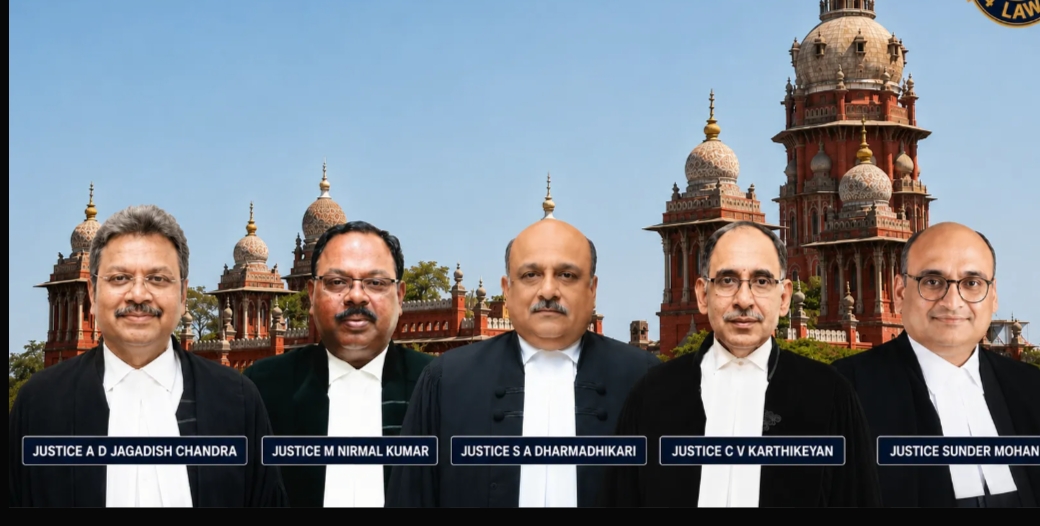
Vs
1. The Secretary to Government of Tamil Nadu Home Department, Fort St.George, Chennai-600 009.
2. The Deputy Inspector General of Police
Vellore Range, Prison Department, Vellore District.
3. The Superintendent of Prisons
Central Prison Cuddalore, Cuddalore District.
Respondent(s) W.P.Crl.No.1167 of 2025
Kuppu
W/o.Murugan,
No.4/445, Pooniyamman Kovil 2nd Street, S.Kolathur, Kovilapakkam, Chennai-600 017.
Petitioner(s)
Vs 1. The State Rep by the
Deputy Inspector General of Prisons, Gandhi Irwin Road, Egmore, Chennai-600 008.
2. The Superintendent, Puzhal Central Prison-I, Puzhal-600 066.
Respondent(s)
W.P.Crl.No.1244 of 2025
Amul
W/o.Muniyandi,
No.387, M.S.Muthu Nagar, Kannigapuram, Vyasarpadi, Chennai – 600012.
Petitioner(s)
Vs 1. The Deputy Inspector General of Prisons
Whannels Road, Egmore, Chennai – 600008.
2. The Superintendent of Prison Central Prison, Puzhal, Chennai – 600066.
Respondent(s)
W.P.Crl.No.1321 of 2025
R.Rajeswari
W/o.Ramkumar
No.124/1-6, Thoppu Street,
Kuthalam, Neikuppai, Pandaravadai, Vazhur,
Nagapattinam District-401.
Petitioner(s)
Vs
1. The Additional Director General of Police and Inspector General of Prisons Whannels Road, Egmore, Chennai-600 008.
2. The Superintendent of Prison
Central Prison Puzhal-I, Chennai District.
Respondent(s)
For Petitioner in Mr.R.Sankarasubbu
W.P.Crl.No.722/2025: (Through VC)
For Petitioner in Mr.M.Radhakrishnan
W.P.Crl.No.1167/2025: for Ms.S.Sadhana
For Petitioner in Mr.R.Muniyapparaj
W.P.Crl.No.1244/2025: for M/s.S.Nadhiya
For Petitioner in Mr.Janardhanan
W.P.Crl.No.1321/2025: for Mr.P.Muthamizhselvakumar
For Respondents in all cases: Mr.R.John Sathyan State Public Prosecutor for Mr.C.R.Malarvannan and Mr.A.Mohammed Imran Government Advocate
Mr.Abudu Kumar Rajaratnam Senior Advocate [Amicus Curiae] assisted by Mr.Thiruvadi Kumar
ORDER
(Order of the Court was made by the Hon’ble Chief Justice)
We have heard learned counsel for the petitioners; Mr.R.John Sathyan, learned State Public Prosecutor, and Mr.Abudu Kumar Rajaratnam, learned Amicus Curiae.
THE GENESIS OF THE REFERENCE :
2. This Larger Bench has been constituted to resolve a judicial dichotomy emerging from the conflicting pronouncements of two coordinate Full Benches of this Court. The central axis of this controversy is the interpretation of the Tamil Nadu Suspension of Sentence Rules, 1982 [for brevity “the 1982 Rules”], and the extent of the State’s executive power to grant ordinary or emergency leave to convicts whose appeals are currently sub judice. The order of
reference dated 19.11.2025 underscores an apparent
irreconcilability between the decision in State v. Yesu @ Velaiyan and the more recent view in T.Ramalakshmi v. State and others .
THE QUESTIONS REFERRED
3. The Division Bench, vide the order of reference, has sought our authoritative opinion on the following questions:
i. Whether leave under Tamil Nadu Suspension of Sentence Rules, 1982, can be granted to a prisoner under Article 226 of the Constitution of India, when his appeal against conviction is pending either before the Hon’ble Supreme Court or this Court?
ii. Whether the power to exempt under Rule 40 of the Tamil Nadu Suspension of Sentence Rules, 1982 can be exercised by the State to grant leave to a prisoner outside the scope of the said Rules when his appeal against conviction is pending before the Hon’ble Supreme Court or this Court in the light of the decision of the Constitution Bench of the Hon’ble Supreme Court in K.M.Nanavati v. State of Bombay ?
SUBMISSIONS OF THE AMICUS CURIAE AND PRESENT POSITION OF LAW
4. Learned Amicus has significantly enriched these proceedings by pointing out that the very soul of this reference, viz., the harmonization of remission and leave policies, is currently under the active scrutiny of the Supreme Court in Mukesh Kumar v. State (Govt. of NCT of Delhi) [MA No. 1658/2023 in Crl.A. No. 1343/2012]. As per the orders of the Apex Court dated 02.04.2024 and 16.04.2024, the State of Tamil Nadu has been impleaded as a party respondent. The relevant observations contained in the said orders are reproduced hereunder:
Order dated 02.04.2024:
In continuation of the previous orders and pursuant to the personal visit to Tihar Jail, Mr. Gaurav Agrawal, learned Senior Counsel representing the National Legal Services Authority (NALSA), in his brief note has, inter alia, pointed out that :
(i) …
(ii) Some of the States do not provide parole/furlough to a convict during the pendency of his appeal before the High Court against conviction. The parole and furlough is denied on the premise that such a convict can seek appropriate orders from the High Court. Learned Senior Counsel points out that parole and furlough are distinct and different than the order of suspension of sentence and/or release of a convict on interim/regular bail. While the later can be granted by the High Court, the convict can be released on parole/furlough only by the competent authority of the State Government in accordance with the rules/policy.
Order dated 16.04.2024:
1. The respondent-States have been served. We are informed that learned Solicitor General will assist the Court on behalf of Union of India. The States of Haryana, Jharkhand, Punjab and Bihar have filed their response. We are informed that State of Telangana has also filed its response.
2. Let other States also do the needful within two weeks. Union of India may also place on record its response/suggestions.”
5. It is stated by learned Amicus that the Supreme Court is currently navigating the complexities of State-specific prison rules to evaluate the feasibility of a “Pan-India” policy.
6. Given the fact that the State of Tamil Nadu is yet to file its
response in those proceedings and the Supreme Court is considering whether a uniform set of rules can be drafted for the entire nation, it is imperative that our interim approach aligns with the progressive evolution of the law at the highest level.
STATUTORY INTERPRETATION: THE AMBIT OF “SENTENCE”
7. The 1982 Rules were notified in exercise of the powers conferred by Section 432(5) of the Code of Criminal Procedure, 1973.
8. A pivotal point of contention is the definition of “sentence” under Rule 2(4) of the 1982 Rules, which reads thus:
“2. Definition – In these rules, unless the context otherwise required-
(1) to (3) …
(4) ‘sentence’ means a sentence as finally fixed on appeal or revision or otherwise and includes an aggregate of more sentence than one sentence in default of fine shall not be taken into consideration while fixing eligibility for being released on leave.”
[emphasis supplied]
9. Learned Amicus rightly relies upon a Constitution Bench decision in Lila Vati Bai v. State of Bombay , wherein the phrase “or otherwise” was interpreted not as a term of limitation, but of broad extension. The relevant portion of the said decision is reproduced hereunder:
“14. As an offshoot of the argument that we have just been examining it was contended on behalf of the petitioner that Explanation (a) to Section 6 quoted above contemplates a vacancy when a tenant (omitting other words not necessary) “ceases to be in occupation upon termination of his tenancy, eviction, or assignment or transfer in any other manner of his interest in the premises or otherwise”. The argument proceeds further to the effect that in the instant case admittedly there was no
termination, eviction, assignment or transfer and that the words “or otherwise” must be construed as ejusdem generis with the words immediately preceding them: and that therefore on the facts as admitted even in the affidavit filed on behalf of the Government there was in law no vacancy. In the first place, as already indicated, we cannot go behind the declaration made by the Government that there was a vacancy. In the second place, the rule of ejusdem generis sought to be pressed in aid of the petitioner can possibly have no application. The legislature has been cautious and thorough-going enough to bar all avenues of escape by using the words “or otherwise”. Those words are not words of limitation but of extension so as to cover all possible ways in which a vacancy may occur. Generally speaking, a tenant’s occupation of his premises ceases when his tenancy is terminated by acts of parties or by operation of law or by eviction by the landlord or by assignment or transfer of the tenant’s interest. But the legislature, when it used the words “or otherwise”, apparently intended to cover other cases which may not come within the meaning of the preceding clauses, for example, a case where the tenant’s occupation has ceased as a result of trespass by a third party. The legislature, in our opinion, intended to cover all possible cases of vacancy occurring due to any reasons whatsoever. Hence, far from using those words ejusdem generis with the preceding clauses of the Explanation, the legislature used those words in an all-inclusive sense. No decided case of any court, holding that the word “or otherwise” have ever been used in the sense contended for on behalf of the petitioner, has been brought to our notice.”
[emphasis supplied]
10. We find merit in the argument that while an appeal is pending, the conviction is not “finally fixed” in the sense of absolute finality, yet the status of the individual has legally transitioned from an “under-trial” to a “convict.”
11. Furthermore, Rule 35 of the 1982 Rules specifically bars its application only to those “pending trial”. Rule 35 of the 1982
Rules reads thus:
“Pending cases – No prisoner on whom case is
pending trail shall be granted leave.”
[emphasis supplied]
12. We are prima facie of the view that, by necessary implication, the 1982 Rules remain a potent instrument for reformative leave for all other categories of prisoners, including those in the appellate stage. To deny the benefit of the 1982 Rules to the prisoners would be to ignore the explicit exclusionary boundary set by Rule 35 of the 1982 Rules.
HUMAN DIGNITY AND THE WRIT JURISDICTION
13. We must reaffirm that incarceration does not render the fundamental rights a “parchment promise.” In State of A.P. v. Challa Ramkrishna Reddy , the Supreme Court held at Paragraphs
22 and 27:
“22. Right to life is one of the basic human rights. It is guaranteed to every person by Article 21 of the Constitution and not even the State has the authority to violate that right. A prisoner, be he a convict or undertrial or a detenu, does not cease to be a human being. Even when lodged in the jail, he continues to enjoy all his fundamental rights including the right to life guaranteed to him under the Constitution. On being convicted of crime and deprived of their liberty in accordance with the procedure established by law, prisoners still retain the residue of constitutional rights.
…
27. In Francis Coralie Mullin v. Administrator, Union Territory of Delhi [AIR 1981 SC 746] the Court held that right to life means the right to live with basic human dignity. In this case, the petitioner, who was a British national and was detained in Central Jail, Tihar, had approached this Court through a petition of habeas corpus in which it was stated that she experienced considerable difficulty in having interview with her lawyer and the members of her family. She stated that her daughter, who was 5 years of age, and her sister who was looking after the daughter, were permitted to have interview with her only once in a month. Considering the petition, Bhagwati, J. (as he then was) observed at AIR pp.
753-54 in para 8 as under: (SCC pp. 619-20, para 9)
‘9. The same consequence would follow even if this problem is considered from the point of view of the right to personal liberty enshrined in Article 21, for the right to have interviews with members of the family and friends is clearly part of personal liberty guaranteed under that article. The expression ‘personal liberty’ occurring in Article 21 has been given a broad and liberal interpretation in Maneka Gandhi case [(1978) 1 SCC 248] and it has been held in that case that the expression ‘personal liberty’ used in that article is of the widest amplitude and it covers a variety of rights which go to constitute the personal liberty of a man and it also includes rights which ‘have been raised to the status of distinct fundamental rights and given additional protection under Article 19’. There can therefore be no doubt that ‘personal liberty’ would include the right to socialise with members of the family and friends subject, of course, to any valid prison regulations and under Articles 14 and 21, such prison regulations must be reasonable and non-arbitrary. If any prison regulation or procedure laid down by it regulating the right to have interviews with members of the family and friends is arbitrary or unreasonable, it would be liable to be struck down as invalid as being
violative of Articles 14 and 21.’
(See also: Sunil Batra v. Delhi Admn. [(1978) 4 SCC
494] and Sunil Batra (II) v. Delhi Admn. [(1980) 3
SCC 488] )”
[emphasis supplied]
14. The power of this Court under Article 226 to ensure the protection of these rights remains an indestructible part of the basic structure of our Constitution. As noted in Hari Krishna Mandir Trust v. State of Maharashtra , the High Courts are duty-bound to exercise this power to prevent injustice. It is seemly to refer to the following observations made in the said decision:
“100. The High Courts exercising their jurisdiction under Article 226 of the Constitution of India, not only have the power to issue a writ of mandamus or in the nature of mandamus, but are duty-bound to exercise such power, where the Government or a public authority has failed to exercise or has wrongly exercised discretion conferred upon it by a statute, or a rule, or a policy decision of the Government or has exercised such discretion mala fide, or on irrelevant consideration.
101. In all such cases, the High Court must issue a writ of mandamus and give directions to compel performance in an appropriate and lawful manner of the discretion conferred upon the Government or a public authority.”
[emphasis supplied]
15. We are, thus, of the view that leave and temporary release are facets of human dignity that cannot be suspended indefinitely merely due to the pendency of a judicial appeal.
DISTINGUISHING FACTS OF K.M.NANAVATI CASE & YESU CASE
16.1. The decision in K.M. Nanavati v. State of Bombay was anchored in a peculiar factual matrix—a direct clash between an executive order of suspension and a judicial warrant during the pendency of a Special Leave Petition. It did not deal with preexisting, statutory reformative rules like the 1982 Rules. To apply Nanavati as a per se bar to the 1982 Rules would be to misapply a precedent born of executive overreach to a field governed by settled statutory policy.
16.2 We may also note here that in that case, the Governor had suspended the sentence, until the disposal of the appeal intended to be filed by the convict before the Supreme Court. It is in that fact situation that the Supreme Court had held that it is for the Supreme Court to consider whether the convict should be granted bail or to surrender to his sentence and that the Governor had no power to grant suspension of the sentence for the period during which the matter was sub judice before the Supreme Court. Prima facie, we are of the view that the said decision would not be an impediment for the authorities concerned to consider the temporary release of the convicts. In the State of Tamil Nadu, there are no rules governing the temporary release of convicts for any exigencies except the 1982 Rules. The fact that the 1982 Rules are called Suspension of Sentence Rules and the Rules have been framed under section 432(5) Cr.P.C. would make no difference as what is governed by the 1982 Rules is temporary release of the convicts. The grant of leave for a temporary period, which can extend to a maximum of 40 days per annum, would not in any way interfere with the power of this Court or any appellate Court to grant or deny the suspension of sentence pending the appeal.
17. It is also necessary to advert to and distinguish the decision in Yesu (supra), which has been cited as the source of the conflicting view animating this reference. A careful reading of Yesu (supra) discloses that the Full Bench therein was concerned with an altogether distinct question, namely, whether “parole”, understood as an administrative, executive release outside the framework of any statute, could be granted in the State of Tamil Nadu at all, and whether, if granted, the period spent on parole was liable to be counted towards the sentence undergone. The Full Bench answered that question by drawing a sharp conceptual distinction between “parole” simpliciter, which does not disrupt the running of the sentence, and “suspension of sentence” granted under the 1982 Rules, which does. It went on to hold that since the State of Tamil Nadu had, as of that date, framed no Rules or administrative instructions under Article 162 of the Constitution regulating the grant of parole, no authority, including the Government, possessed the power to grant temporary release by way of parole, and that any such release purportedly granted would, for want of a governing statute, have to be treated only as suspension of sentence under the 1982 Rules and not as parole. The decision in Yesu (supra), therefore, never considered and did not pronounce upon, the question now referred to us, viz., whether leave under the 1982 Rules may be granted to a prisoner whose appeal against conviction is pending before this Court or the Supreme Court. Its ratio is confined to the field occupied by Rule 36 of the 1982 Rules, that any period of leave thereunder does not count towards sentence served, and to the impermissibility of parole de hors the Rules. To the extent Yesu (supra) is invoked as authority for the proposition that the 1982 Rules cannot be resorted to during the pendency of an appeal, such reliance proceeds upon a misreading, since the judgment contains no such finding, express or implied.
18. The subsequent Full Bench in T. Ramalakshmi v. State (2025) 1 LW (Cri) 310, by contrast, directly and exhaustively considered the question of grant of leave during pendency of appeal with reference to Rules 22, 35 and 40 of the 1982 Rules, and we are in respectful agreement with the reasoning therein, for the reasons already recorded above.
INTERIM FIELD OF LAW AND STAY OF EMBARGO
19. Pending the resolution of the questions by this Larger
Bench and the final decision of the Apex Court in the Mukesh Kumar case (supra), which is stated to govern the whole nation, a state of legal uncertainty cannot be allowed to prejudice the liberty of convict prisoners. The order of reference dated 19.11.2025, at paragraph 34, directed the Registry not to entertain any applications for leave. We find that this embargo creates an immediate and potentially irreparable hardship.
20. The decision in T.Ramalakshmi v. State (supra) currently represents the most comprehensive and modern interpretation of the 1982 Rules. Until a higher authority directs otherwise, it is the most suitable precedent to govern the field.
THE ORDER
21. In light of the foregoing, we pass the following interim directions:
(i) The operation of the direction issued in Paragraph 34 of the order of reference dated 19.11.2025, which restrained the Registry from entertaining applications for emergency or ordinary leave under the 1982 Rules, is hereby kept in abeyance. The Registry shall entertain the petitions in terms of the Full Bench decision in T.Ramalakshmi (supra).
(ii) Pending the final determination of this reference and the proceedings in Mukesh Kumar v. State (supra) before the Supreme Court, the judgment of the Full Bench of this Court in T.Ramalakshmi v. State and others (supra) shall hold the field and govern the grant of leave.
(iii) The competent Prison Authorities are directed to process applications for ordinary and emergency leave in accordance with the 1982 Rules and the guidelines established
in T.Ramalakshmi (supra), adjudicating each on its individual merits. Let a copy of this order be marked to the Secretary to Government, Home Department, Fort St. George, Chennai, to give necessary instructions to the authorities concerned across the State.
(iv) The decision in K.M. Nanavati (supra) shall not be construed as an automatic bar to the consideration of leave applications under the statutory rules during the interim period.
22. All these writ petitions be listed before the Division Bench concerned for passing necessary orders in light of the observations made in the preceding paragraphs.
23. The Registry is, however, directed to list these matters before this Larger Bench after the Supreme Court renders its decision in Mukesh Kumar case (supra), as it is submitted that the Supreme Court is navigating the complexities of State-specific prison rules to evaluate the feasibility of a “Pan-India” policy and the decision will have a directing bearing on the issues referred.
24. During the course of hearing, the learned Amicus Curiae and the other members of the Bar brought to our notice another decision of a Division Bench of this Court in Rajammal vs. The Deputy Inspector General of Prisons and Correctional Services Department8, holding the decision in Latha v. State9 and consequently, the Full Bench judgment in T.Ramalakshmi’s case (supra), per incuriam. This decision was rendered when the reference before this Bench was pending.
25. The Division Bench in Latha’s case (supra) had considered the judgment of the Supreme Court in Nanavati’s case (supra) and took a view which was approved by the Full bench in
T.Ramalakshmi’s case (supra). Those decisions cannot be said to be per incuriam even assuming that a different view is possible. The law relating to judicial discipline and as to when a judgment could be stated to be per incuriam is well settled in this regard.
26. Before parting with this stage of the proceedings, this Court deems it appropriate to place on record its profound appreciation and commendation for the learned Amicus. His meticulous research, erudite submissions, and the comprehensive
8 2026 (2) MLJ (Crl.) 476
9 2023 MHC 5402
nature of the materials placed before us have been of invaluable assistance in navigating the complex constitutional and statutory thickets inherent in this reference.
(SUSHRUT ARVIND DHARMADHIKARI, C.J.)
(C.V.KARTHIKEYAN J.) (A.D.JAGADISH CHANDIRA J.)
(M.NIRMAL KUMAR J.) (SUNDER MOHAN J.)
19.06.2026
Index: Yes/No
NC : Yes/No
sasi
THE HON’BLE CHIEF JUSTICE C.V.KARTHIKEYAN J. A.D.JAGADISH CHANDIRA J. M.NIRMAL KUMAR J.
AND SUNDER MOHAN J.
(sasi)
WP Crl. No s .722, 1244,
1321 and 1167 of 2025
19.06.2026