The Madras High Court has directed that applications seeking ordinary and emergency leave under the Tamil Nadu Suspension of Sentence Rules, 1982, shall once again be entertained pending the adjudication of a reference by a Five-Judge Bench and the Supreme Court’s consideration of a similar issue in Mukesh Kumar v. State (Govt. of NCT of Delhi).
The Madras High Court has directed that applications seeking ordinary and emergency leave under the Tamil Nadu Suspension of Sentence Rules, 1982, shall once again be entertained pending the adjudication of a reference by a Five-Judge Bench and the Supreme Court’s consideration of a similar issue in Mukesh Kumar v. State (Govt. of NCT of Delhi).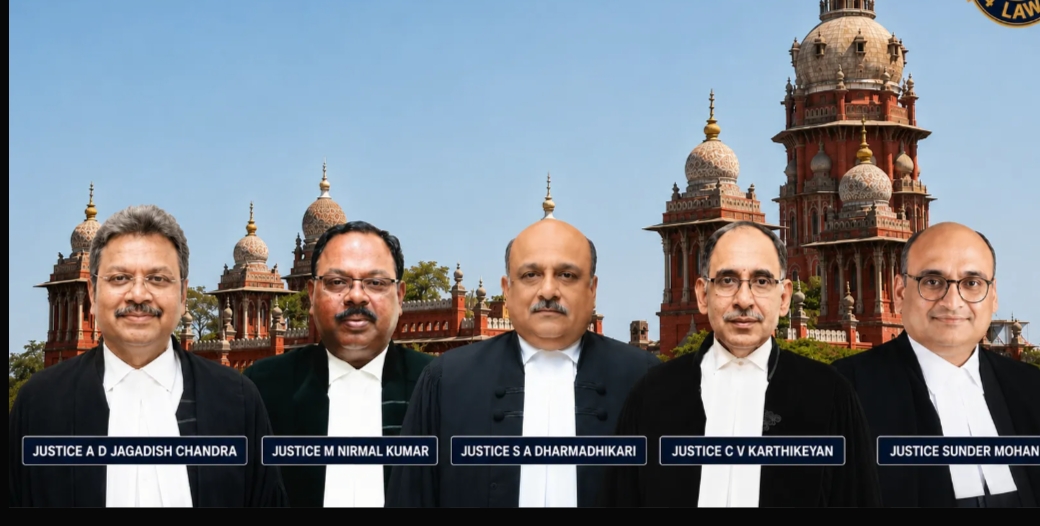

The Five-Judge Bench comprising Chief Justice Sushrut Arvind Dharmadhikari, Justice C.V. Karthikeyan, Justice A.D. Jagadish Chandira, Justice M. Nirmal Kumar and Justice Sunder Mohan is examining whether leave under the Tamil Nadu Suspension of Sentence Rules, 1982, can be granted to convicted prisoners whose appeals against conviction are pending before the High Court or the Supreme Court. The reference also concerns whether the State can exercise its power of exemption under Rule 40 of the Rules in light of the Constitution Bench decision in K.M. Nanavati v. State of Bombay.
Appearing as Amicus Curiae, Senior Advocate Abudu Kumar Rajaratnam brought to the Court’s notice that the issue of harmonisation of remission and leave policies is presently under consideration before the Hon’ble Supreme Court in Mukesh Kumar v. State (Govt. of NCT of Delhi). Referring to the Supreme Court’s orders dated April 2 and April 16, 2024, he pointed out that the State of Tamil Nadu had been impleaded in the proceedings. He further brought to the Bench’s attention the observations of the Supreme Court that some States deny parole and furlough during the pendency of appeals on the premise that the appellate court can grant suspension of sentence or bail, whereas parole and furlough are distinct forms of temporary release to be granted by the competent State authority in accordance with the applicable rules or policy. The Amicus also informed the Court that the Supreme Court is presently examining the prison rules of various States to evaluate the feasibility of a “Pan-India” policy.
The Amicus further relied upon the constitutional guarantee under Article 21 and submitted that imprisonment does not extinguish a prisoner’s fundamental rights. Placing reliance on decisions recognising the right to live with dignity and maintain family and social ties, he contended that temporary leave is a reformative measure consistent with constitutional protections.
He also referred to the scope of the High Court’s jurisdiction under Article 226, submitting that where statutory authorities fail to exercise the discretion vested in them under the Rules, the High Court is empowered to issue appropriate directions, including a writ of mandamus, to ensure that such discretion is exercised lawfully.
Taking note of the submissions, the Bench observed that the issue before it formed part of a larger exercise presently underway before the Supreme Court and held that, since the State of Tamil Nadu was yet to file its response in those proceedings and the Apex Court was considering the feasibility of a uniform set of rules for the entire country, its interim approach should align with the progressive evolution of the law at the highest level.
On a prima facie interpretation of the Tamil Nadu Suspension of Sentence Rules, the Bench observed that Rule 35 excludes only prisoners whose criminal cases are pending trial and does not expressly exclude convicted prisoners whose appeals are pending. It was of the view that the statutory scheme continues to apply to prisoners at the appellate stage and that denying the benefit of the Rules would amount to ignoring the express exclusion contained in Rule 35.
The Court further held that temporary leave is connected with the constitutional guarantee of human dignity under Article 21 and that incarceration does not extinguish a prisoner’s fundamental rights. It observed that leave and temporary release are facets of human dignity that cannot be suspended indefinitely merely because an appeal against conviction is pending.
The Bench distinguished the Constitution Bench decision in K.M. Nanavati v. State of Bombay, observing that the case arose out of a challenge to the Governor’s order suspending the sentence of a convict until the disposal of the appeal proposed to be filed before the Supreme Court. The Bench was, prima facie, of the view that the decision would not impede the competent authorities from considering the temporary release of convicts under the Tamil Nadu Suspension of Sentence Rules, 1982. It further observed that the Rules govern the temporary release of convicts and that the grant of leave for a limited period, extending up to 40 days in a year, would not interfere with the power of the High Court or any appellate court to grant or refuse suspension of sentence pending appeal.
The Bench also clarified that the Full Bench decision in State v. Yesu @ Velaiyan did not decide whether leave under the 1982 Rules could be granted during the pendency of criminal appeals and that reliance on the decision for such a proposition was misplaced. Expressing agreement with the reasoning adopted by the subsequent Full Bench in T. Ramalakshmi v. State, the Court held that the latter would continue to govern the field until the reference is finally answered or the Supreme Court decides the issue in Mukesh Kumar.
Accordingly, the Court kept in abeyance the earlier direction contained in the order of reference dated November 19, 2025, restraining the Registry from entertaining applications for ordinary and emergency leave. It directed the Registry to entertain such petitions and directed the competent prison authorities to consider applications for leave on their individual merits in accordance with the 1982 Rules and the principles laid down in T. Ramalakshmi. The Court also clarified that the decision in K.M. Nanavati should not be construed as an automatic bar to the consideration of leave applications during the interim period.
The Court further took note of the subsequent Division Bench decision in Rajammal v. Deputy Inspector General of Prisons, which had held Latha v. State and, consequently, T. Ramalakshmi to be per incuriam. The Larger Bench observed that those decisions could not be regarded as per incuriam merely because another interpretation of the law was possible and left the larger issues for final determination after the Supreme Court renders its decision in Mukesh Kumar.
Before concluding the hearing, the Bench recorded its appreciation for the assistance rendered by the Amicus Curiae, observing that his meticulous research, erudite submissions and the comprehensive nature of the materials placed before the Court had been of invaluable assistance in navigating the complex constitutional and statutory issues arising in the reference.