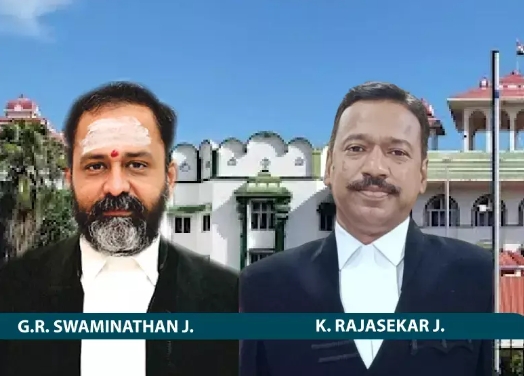
20.We, therefore, hold that this writ petition is maintainable. The learned Single Judge rightly quashed the order of termination passed against the writ petitioner. Since we dismiss this writ appeal, the writ petitioner has to be necessarily reinstated with all the benefits. 21.This writ appeal is dismissed with the aforesaid directions. No costs. Consequently, connected miscellaneous petition is closed. (G.R.S. J.,) & (K.R.S. J.,) 04.08.2025 NCC : Yes/No Index : Yes / No Internet : Yes/ No ias/SKM To 1.The Director, Bharathidasan Institute of Management, MHD Campus, BHEL Complex, Tiruchirappalli – 620 014. 2.The Registrar, Bharathidasan University, Palkalaiperur, Tiruchirappalli – 620 024. 3.The Chairman, Bharathidasan Institute of Management, MHD Campus, BHEL Complex, Tiruchirappalli – 620 014. G.R.SWAMINATHAN, J. and K.RAJASEKAR, J. ias/SKM W.A.(MD)No.2107 of 2023 04.08.2025
BEFORE THE MADURAI BENCH OF MADRAS HIGH COURT
DATED : 04.08.2025
CORAM
THE HONOURABLE MR.JUSTICE G.R.SWAMINATHAN and
THE HONOURABLE MR.JUSTICE K.RAJASEKAR
W.A.(MD)No.2107 of 2023 and
C.M.P.(MD)No.16820 of 2023
1.The Director,
Bharathidasan Institute of Management,
MHD Campus, BHEL Complex, Tiruchirappalli – 620 014.
2.Dr.Asith Kumar Barma,
The Director,
Bharathidasan Institute of Management,
MHD Campus, BHEL Complex,
Tiruchirappalli – 620 014. … Appellants
Vs.
1.Dr.C.N.S.Ramnath Babu
2.The Registrar, Bharathidasan University, Palkalaiperur, Tiruchirappalli – 620 024.
3.The Chairman,
Bharathidasan Institute of Management,
MHD Campus, BHEL Complex,
Tiruchirappalli – 620 014. … Respondents Prayer : Writ Appeal filed under Clause XV of Letters Patent, to allow the writ appeal by setting aside the order passed in W.P.(MD)No.19133 of 2023 dated 02.11.2023 on the file of this Court.
For Appellants : Mr.P.H.Aravind Pandian, Senior Counsel, for Mr.Vikram Veerasamy.
For Respondents : Mr.Murugesh Ramiah for R1
Mr.V.R.Shanmuganathan for R2 & R3.
JUDGMENT
(By G.R.SWAMINATHAN, J.)
This writ appeal is directed against the order dated 02.11.2023 made in WP(MD)No.19133 of 2023 filed by the first respondent herein (hereinafter referred to as the writ petitioner).
2.The writ petitioner belongs to a Scheduled Caste. He is a holder of B.E. Mechanical degree from National Institute of Technology, Tiruchirappalli. He subsequently acquired MBA in Marketing at Bharathidasan Institute of Management, Tiruchirappalli (appellant herein) and Ph.D. (Marketing) degree from Bharathidasan University, Tiruchirappalli. When the appellant institution called for applications from eligible candidates for the post of Assistant Professor in December 2020, the writ petitioner applied in response thereto. By then, he had around 13 years of industrial experience and 12 years of teaching experience. He was then serving in Xavier Institute of Management and Entrepreneurship, Bangalore. An expert selection committee was constituted and interview was held on 28.01.2021. The writ petitioner was selected. The first appellant vide order dated 12.03.2021 offered the writ petitioner the faculty position of Assistant Professor. The writ petitioner accepted the offer and joined duty on 16.04.2021.
3.As per the appointment order, the writ petitioner was appointed on probation for a period of two years. His appointment was to be confirmed only on satisfactory completion of probation. It was further specified that during the probation period, the appointment may be terminated by either side by giving one month’s notice or one month’s salary in lieu thereof. The writ petitioner’s probation ended on 15.04.2023. His probation, however, was not declared and his appointment was not confirmed. Instead, on 07.07.2023, he was relieved permanently from his position. Instead of giving one month’s notice pay, three months salary was credited to his account. In fact, the writ petitioner received two sets of communication terminating him from service. The writ petitioner tried to argue that the stand of the management was not fair. Since there was no response to his representation sent through e-mail, he filed W.P.(MD)No.19133 of 2023 challenging the termination order and seeking reinstatement with consequential benefits. The management filed a detailed counter-affidavit controverting the assertions made by the writ petitioner as well as questioning the very maintainability of the writ petition.
4.The learned Single Judge framed the issues as follows:-
“(I) Whether this writ petition is liable to be dismissed on the question of maintainability ?
(II) Whether the impugned termination order and consequential relieving order dated 07.07.2023 is a termination simpliciter during probation ?
(III) Whether the impugned termination order and consequential relieving order is vitiated by malafides ?
(IV) Whether the impugned termination order and consequential relieving order has been issued violating the statutes of BIM and principles of natural justice ?”
5.After an elaborate discussion, the learned Single Judge concluded that the writ petition was maintainable and that the management has passed a stigmatic order without complying with the principles of natural justice. It was further concluded that the termination order could have been issued only by the Board of Governors and not by the Director in his individual capacity. In that view of the matter, the writ petition was disposed of in the following terms:-
“53.In view of the same, this Court hereby quash the impugned order of termination and consequential relieving order dated 07.07.2023 on the ground of jurisdiction alone and thereafter, remand back the matter to the third respondent with the following directions:-
(i)The third respondent is directed to place the case of the writ petitioner before the Board of Governors for appropriate action.
(ii)In case the Board of Governors decide to terminate the writ petitioner appropriate opportunity of hearing should be given to the writ petitioner to explain the allegations put forthwith against him by the third respondent along with supporting documents.
(iii)The Board of Governors while deciding the case of the writ petitioner should keep in mind the past professional experience of the writ petitioner, present age of the writ petitioner, family circumstances and future employment prospects of the writ petitioner.
(iv)In case of arriving at conclusion to terminate the writ petitioner after giving him due opportunity in accordance with law, the order of termination should not be stigmatic.”
Aggrieved by the same, the management has filed this writ appeal.
6.The learned Senior Counsel for the appellants contended that the issue regarding maintainability is no longer res integra. He pointed out that the Hon’ble Supreme Court of India had settled the issue after a threadbare discussion of all the earlier precedents in the decision reported in (2023) 4 SCC 498 (St.Mary’s Educational Society Vs. Rajendra Prasad Bhargava). He pointed out that this was subsequently followed in AIR 2024 SC (Supp) 801 (Army Welfare Education Society, New Delhi Vs. Sunil Kumar Sharma). He also added that when a writ petition was filed against Indian Institute of Management, Kozhikode by a terminated employee, the Kerala High Court dismissed the writ petition as not maintainable (2023) 4 KLT 365 (Shiny George Ambat Vs. Union of India). According to the learned Senior Counsel, the merits of the matter need not be gone into at all. Even if the order impugned in the writ petition is held to be stigmatic, still that would not make any difference because the writ petition itself is not maintainable. This is all the more so because, Bharathidasan Institute of Management is no longer a unit or part of Bharathidasan University. The umbilical cord between the appellant-institution and the University was severed long time ago. The appellant-institution is not receiving any aid or funds from the
University. His firm contention is that Bharathidasan Institution of
Management is not a State or State Instrumentality within the meaning of Article 12 of the Constitution of India. He called upon this Court to set aside the order of the learned Single Judge and allow the writ appeal.
7.Per contra, the learned counsel for the writ petitioner submitted that the impugned order is well reasoned and that it does not call for interference.
8.We carefully considered the rival contentions and went through the materials on record. As already mentioned, the writ petitioner belongs to a Scheduled Caste. He has specifically alleged caste discrimination on the part of the first appellant. He had taken up the matter even up to the National Commission for Scheduled Castes. The learned Single Judge had negated the same on the ground that the same has been pleaded only as an afterthought in the reply affidavit.
9.Thanks to the constitutional focus on social justice, the soul of the suppressed communities is beginning to find utterance (to borrow from Shri Jawaharlal Nehru’s “A Tryst With Destiny”). We would remind those in management to be more sensitive while assessing the performance of those who hail from the oppressed sections. Otherwise, those under the scanner would feel tyrannized in the name of merit (To borrow from the title of Micheal J.Sandel’s book). The concept of reasonable accommodation which hitherto is associated only with disability law has to be extended while implementing affirmative programmes. Only then, substantive justice can be achieved.
10.If the writ petitioner fell short, the persons at the helm of affairs ought to have called him for counselling and motivated him. Such a sensitive approach does not appear to have been adopted in the instant case. That has probably embittered the writ petitioner all the more.
11.We may not endorse the stand of the learned Single Judge that the Director does not have the jurisdiction to terminate a probationer. When the appointment order has been issued by the Director, there is no reason as to why a termination order cannot also be issued by him.
12.The learned Single Judge held that the writ petitioner was maintainable for the following reasons:-
“23.Section 2k of the laws of Bharathidasan University defines School of Excellence as follows:- “’School of excellence’ means an institution, governed by a separate Board of Governors and registered under Societies Registration Act, sponsored by and affiliated to the University for Postgraduate Study and Research.
24.The function of Bharathidasan Institution of Management as per the Memorandum of Association in Clause g(v) mandates to maintain a fund to which all the moneys provided by the University, Central and State Governments shall be credited. Clause g(ix) mandates to forward annually to the Bharathidasan University and the State Government through the University, the accounts of the BIM Society as certified by an auditor appointed by the Board of Governors of the Institution. The Rules of the BIM Society in its definition Clause in Rule (c) defines ‘University’ as ‘University’ shall mean the Bharathidasan University and State Government shall mean the Government of Tamil Nadu. Rule 25 of BIM Society mandates that the memorandum and bylaws of BIM shall be amended by a special resolution subject to the prior approval of the Bharathidasan University and without prejudice to the general powers of the Society and the University. Rule 10 of the BIM mandates that his Excellency Governor of Tamil Nadu (Chancellor of the Bharathidasan University) shall be the Honorary patron in Chief of the Society. That apart his Excellency, the Governor of Tamil Nadu Chancellor of Bharathidasan University would be the Honorary patron in Chief of the Board of Governors of BIM. The policy note of the higher education Department of the Government of Tamil Nadu has recorded that Bharathidasan University besides the main campus at Palkalaiperur and City campus at Kajamalai as Bharathidasan Institution of Management located at Tiruverumbur.
25.From the above details, it is crystal clear that BIM is the school of Excellence/Institution of Bharathidasan University, though governed by a separate Board of Governor and registered under Societies Registration Act. The same is the unit of the Bharathidasan University affiliated to the Bharathidasan University for Post Graduate, Study and Research….
28….In the instant case, the Institution involved is Bharathidasan
Institution of Management which is an unit of Bharathidasan University, to which the Governor of Tamil Nadu is the Chancellor. That apart the Hon’ble Governor of the State of Tamil Nadu is the Honorary Patron in Chief of the Board of Governors of BIM. In addition to that, BIM is a school of excellence, which is sponsored by and affiliated to the Bharathidasan University for post Graduate Study and Research. Certainly BIM is engaged in imparting education in higher studies to students at large and thereby, discharging “public function by way of imparting education”. Pertinently it is a school of excellence affiliated to the Bharathidasan University in terms of Section 2k of the laws of Bharathidasan University. BIM provides for effective discharge of public function namely, education for the benefit of the public. Hence, it is certainly an Authority within the meaning of Article 12 though not state which is coupled with the public duty of imparting education. Precisely I hold that BIM is an Authority as provided under Article 12 and it becomes amenable to the writ jurisdiction of this Court under Article 226 of
Constitution.”
13.It is true that the Hon’ble Supreme Court in the decision reported in (2023) 4 SCC 498 (St. Mary’s Education Society v. Rajendra Prasad Bhargava) held that a writ petition would not lie against an institution imparting education which though discharging public duty does not derive any aid from the State. The conclusions of the Hon’ble Supreme Court have been summarized as follows:-
“75.1. An application under Article 226 of the Constitution is maintainable against a person or a body discharging public duties or public functions. The public duty cast may be either statutory or otherwise and where it is otherwise, the body or the person must be shown to owe that duty or obligation to the public involving the public law element. Similarly, for ascertaining the discharge of public function, it must be established that the body or the person was seeking to achieve the same for the collective benefit of the public or a section of it and the authority to do so must be accepted by the public.
75.2. Even if it be assumed that an educational institution is imparting public duty, the act complained of must have a direct nexus with the discharge of public duty. It is indisputably a public law action which confers a right upon the aggrieved to invoke the extraordinary writ jurisdiction under Article 226 for a prerogative writ. Individual wrongs or breach of mutual contracts without having any public element as its integral part cannot be rectified through a writ petition under Article 226. Wherever Courts have intervened in their exercise of jurisdiction under Article 226, either the service conditions were regulated by the statutory provisions or the employer had the status of “State” within the expansive definition under Article 12 or it was found that the action complained of has public law element.
75.3. It must be consequently held that while a body may be discharging a public function or performing a public duty and thus its actions becoming amenable to judicial review by a constitutional court, its employees would not have the right to invoke the powers of the High Court conferred by Article 226 in respect of matter relating to service where they are not governed or controlled by the statutory provisions. An educational institution may perform myriad functions touching various facets of public life and in the societal sphere. While such of those functions as would fall within the domain of a “public function” or “public duty” be undisputedly open to challenge and scrutiny under Article 226 of the Constitution, the actions or decisions taken solely within the confines of an ordinary contract of service, having no statutory force or backing, cannot be recognised as being amenable to challenge under Article 226 of the Constitution. In the absence of the service conditions being controlled or governed by statutory provisions, the matter would remain in the realm of an ordinary contract of service.
75.4. Even if it be perceived that imparting education by private unaided school is a public duty within the expanded expression of the term, an employee of a non-teaching staff engaged by the school for the purpose of its administration or internal management is only an agency created by it. It is immaterial whether “A” or “B” is employed by school to discharge that duty. In any case, the terms of employment of contract between a school and non-teaching staff cannot and should not be construed to be an inseparable part of the obligation to impart education. This is particularly in respect to the disciplinary proceedings that may be initiated against a particular employee. It is only where the removal of an employee of non-teaching staff is regulated by some statutory provisions, its violation by the employer in contravention of law may be interfered with by the Court. But such interference will be on the ground of breach of law and not on the basis of interference in discharge of public duty.
75.5. From the pleadings in the original writ petition, it is apparent that no element of any public law is agitated or otherwise made out. In other words, the action challenged has no public element and writ of mandamus cannot be issued as the action was essentially of a private character.”
This decision was followed in AIR 2024 SC (Supp) 801 (Army Welfare Education Society, New Delhi Vs. Sunil Kumar Sharma). As pointed out by the learned Senior Counsel for the appellants, the Kerala High Court had held that discharge of a probationer from service could not be a matter in which the court can exercise jurisdiction under Article 226 of the Constitution of India. The contesting respondent in that case was IIM, Kozhikode. The learned Judge had held that IIM, Kozhikode would not fall within the definition of State or Instrumentality of the State under Article 12 of the Constitution. Hence, the High Court of Kerala declined to issue a Writ against the said institution.
14.We do bow before the aforesaid decisions of the Hon’ble
Supreme Court. St.Mary’s was considered by a Three Judges Bench in Dileep Kumar Pandey v. UOI (2025 INSC 749). The majority even while noting that in St.Mary’s, there was no reference to Anandi Mukta Sadguru Shree Muktajee Vandas Swami Suvarna Jayanti Mahotsav
Smarak Trust v. V.R.Rudani (1989) 2 SCC 691 chose to approve St.Mary’s. There is however a dissent by His Lordship Mr.Justice Ahsanuddin Amanullah. His Lordship extensively cites the 1989
decision. The relevant paras are as follows :
18. In Andi Mukta Sadguru Shree Muktajee Vandas Swami
Suvarna Jayanti Mahotsav Smarak Trust v. V R
Rudani, (1989) 2 SCC 691, the question before the Court was whether a mandamus can be issued at the instance of a teacher against a Trust which was running the educational institution. While upholding the maintainability of the writ petition, the Court held thus:
‘15. If the rights are purely of a private character no mandamus can issue. If the management of the college is purely a private body with no public duty mandamus will not lie. These are two exceptions to mandamus. But once these are absent and when the party has no other equally convenient remedy, mandamus cannot be denied. It has to be appreciated that the appellants trust was managing the affiliated college to which public money is paid as government aid. Public money paid as government aid plays a major role in the control, maintenance and working of educational institutions. The aided institutions like government institutions discharge public function by way of imparting education to students. They are subject to the rules and regulations of the affiliating University. Their activities are closely supervised by the University authorities. Employment in such institutions, therefore, is not devoid of any public character. [See The Evolving Indian Administrative Law by M.P. Jain (1983), p. 226] So are the service conditions of the academic staff. When the University takes a decision regarding their pay scales, it will be binding on the management. The service conditions of the academic staff are, therefore, not purely of a private character. It has super-added protection by University decisions creating a legal right-duty relationship between the staff and the management. When there is existence of this relationship, mandamus cannot be refused to the aggrieved party. xxx
20. The term “authority” used in Article 226, in the context, must receive a liberal meaning unlike the term in Article 12. Article 12 is relevant only for the purpose of enforcement of fundamental rights under Article 32. Article 226 confers power on the High Courts to issue writs for enforcement of the fundamental rights as well as non-fundamental rights. The words “any person or authority” used in Article 226 are, therefore, not to be confined only to statutory authorities and instrumentalities of the State. They may cover any other person or body performing public duty. The form of the body concerned is not very much relevant. What is relevant is the nature of the duty imposed on the body. The duty must be judged in the light of positive obligation owed by the person or authority to the affected party. No matter by what means the duty is imposed, if a positive obligation exists mandamus cannot be denied.
xxx
22. Here again we may point out that mandamus cannot be denied on the ground that the duty to be enforced is not imposed by the statute. Commenting on the development of this law, Professor de Smith states:“To be enforceable by mandamus a public duty does not necessarily have to be one imposed by statute. It may be sufficient for the duty to have been imposed by charter, common law, custom or even contract.” [Judicial Review of Administrative
Action, 4th Edn., p. 540] We share this view. The judicial control over the fast expanding maze of bodies affecting the rights of the people should not be put into watertight compartment. It should remain flexible to meet the requirements of variable circumstances. Mandamus is a very wide remedy which must be easily available “to reach injustice wherever it is found”. Technicalities should not come in the way of granting that relief under Article 226. We, therefore, reject the contention urged for the appellants on the maintainability of the writ petition.’
(emphasis supplied)
19. The public duty imparting of education has to be done through teachers. Teachers form the most vital cog of the educational system and act as the link between a school and the students. Any matter affecting the service conditions, morale and discipline among the teaching staff would have a direct bearing and nexus with the imparting of education…”
15.Even in St.Mary’s, it was held that writ petition against an employer having the status of “State” within the expansive definition under Article 12 will be maintainable. The learned Single Judge had held that the Bharathidasan Institution of Management being a School of Excellence founded by the University falls within the scope of Article 12.
It has been demonstrated before us that in the correspondence with
AICTE during extension of approval process, while filling up the column
“Institute Type”, BIM had described itself as “University Managed –
Government”. On some occasions, BIM had called itself “State Government University”. When Bharathidasan University withdrew its affiliation and declined to issue degrees to the students of BIM, BIM filed W.P.(MD)No.9641 of 2022. The said writ petition was allowed by one of us (G.R.S, J.). Thus, even on the anvil of St.Mary’s, the writ petition passes muster.
16.In the facts and circumstances of the case, we hold that the writ petition is maintainable. We, however, rest our order on the ground that the fundamental rights of the writ petitioner have been seriously breached. Let us first look at the order of termination. It reads as follows:-
“You were appointed as Asst. Professor BIM Society, Trichy and joined on the FN of April 16, 2021 During your probation period of two years, your work and performance are not satisfactory, Even though I have warned you several times and yet there has not been any tangible improvement in your teaching activities.
Further, I received several complaints from faculty and students.
In view of your irresponsible activities during the probation period of two years, I feel you had not satisfactorily completed the probation period and hence, it is hereby ordered that you are not fit to hold the post of Assistant Professor at BIM. Hence, you are relieved permanently from the position of Asst. Professor at BIM Society on the afternoon of July 07, 2023. You are further informed that instead of giving one month notice pay per your appointment order, three months salary will be credited to your account.”
17.The expressions used in the termination order are per se stigmatic. One need not be a Shakespeare to come to this conclusion. Any probationer whose performance is not satisfactory can be shown the door by the management without holding any enquiry. But then, the termination order has to read as termination simpliciter. It should not appear to be punitive or stigmatic. If the order is punitive or stigmatic, then, the management has to comply with the principles of natural justice. A stigmatic order passed in breach of the principles of natural justice has to be set aside (vide UP State Road Transport Corporation v. Brijesh Kumar, 2024 INSC 638).
18.If the appellant had passed an order of termination simpliciter without stigmatizing the writ petitioner in any way, we would have unhesitatingly held that the remedy of the aggrieved employee is not before the Writ Court but elsewhere. But by calling the writ petitioner names, the management had seriously violated two fundamental rights of the writ petitioner ie., his right to reputation and his right to livelihood. In the decision reported in 2016 SCC OnLine SC 550 (Subramanian Swamy Vs. Union of India), it was held that the right to reputation would form part of Article 21 of the Constitution of India. The writ petitioner has to carry the cross of stigmatic order on his shoulder forever. When he approaches another institution for work, his antecedents would be verified. “Where were you working earlier?” and “under what circumstances you had to leave ?” would be obvious questions. The termination order would have to be produced. No employer would be chivalrous enough to overlook the same and engage the writ petitioner. Thus, his right to livelihood has also been seriously compromised.
19.In the decision reported in (2023) 4 SCC 1 (Kaushal Kishor Vs. State of U.P.), it has been held that when one’s fundamental rights under Articles 19 and 21 of the Constitution of India are affected, it can be horizontally applied. In other words, it had been authoritatively laid down that fundamental rights under Article 19 / 21 can be enforced even against persons other than the State or its instrumentalities. Even assuming that BIM is not a State or State instrumentality within Article 12 of the Constitution, still Writ can be issued against BIM since it had violated the writ petitioner’s fundamental right under Article 21 of the Constitution. The reputation of the writ petitioner has been severely damaged by the first appellant. If the first appellant wanted to paint the writ petitioner in adverse colors and throw him out, then, it was incumbent on his part to have held an enquiry. Due process was not adopted in this case. We would go to the extent of remarking that the appellants have no defence whatsoever on merits. That is why, they are harping on the plea of maintainability. The writ petitioner deserves a speedy remedy in writ jurisdiction. It is relevant to mention here that the Hon’ble Supreme Court comprising Their Lordships Mr.Justice J.B.Pardiwala and Mr.Justice R.Mahadevan in Gulshan Kumar v. Institute of Banking Personnel Selection (2025) 4 SCC 90 held as
follows :
“26. It is also to be pointed out that the Constitution Bench of this Court in Kaushal Kishor v. State of U.P. [Kaushal Kishor v. State of U.P., (2023) 4 SCC 1] considered the question as to whether fundamental rights under Articles 19 and 21 of the Constitution can be claimed against anyone who is not a State instrumentality, and answered the same in the affirmative with a majority of 4 : 1. It was clarified that rights under Articles 19 and 21 can be enforced even against private entities and it overrides the principle laid down in Rajbir [Rajbir Surajbhan Singh v. Institute of Banking Personnel Selection, (2019) 14 SCC 189 : (2020) 1 SCC (L&S) 836] . Hence, the contention of Respondent 1 that they are not amenable to writ jurisdiction cannot be countenanced by us…” Gulshan Kumar was a case pertaining to persons with physical disability. The case on hand is all about social disability. When the fundamental right under Article 21 is violated, the constitutional court cannot keep quiet. The status of the tormentor is irrelevant. Whether it is the State or an individual, the court has to rush to rescue the victim. This is all the more so because the victim hails from a marginalised background.
20.We, therefore, hold that this writ petition is maintainable. The learned Single Judge rightly quashed the order of termination passed against the writ petitioner. Since we dismiss this writ appeal, the writ petitioner has to be necessarily reinstated with all the benefits.
21.This writ appeal is dismissed with the aforesaid directions. No costs. Consequently, connected miscellaneous petition is closed.
(G.R.S. J.,) & (K.R.S. J.,)
04.08.2025
NCC : Yes/No
Index : Yes / No Internet : Yes/ No ias/SKM
To
1.The Director, Bharathidasan Institute of Management,
MHD Campus, BHEL Complex, Tiruchirappalli – 620 014.
2.The Registrar, Bharathidasan University, Palkalaiperur, Tiruchirappalli – 620 024.
3.The Chairman,
Bharathidasan Institute of Management,
MHD Campus, BHEL Complex,
Tiruchirappalli – 620 014.
G.R.SWAMINATHAN, J. and K.RAJASEKAR, J.
ias/SKM W.A.(MD)No.2107 of 2023
04.08.2025