9.Accordingly, the criminal appeal stands allowed. Since the judgment of conviction and sentence has been set aside by us, the appellants will continue to be on bail. Consequently, connected miscellaneous petition is closed. (G.R.S., J.) & V.L.N., J
IN THE HIGH COURT OF JUDICATURE AT MADRAS
DATED: 29-05-2026
CORAM
THE HON’BLE MR.JUSTICE G.R.SWAMINATHAN and
THE HON’BLE MR. JUSTICE V.LAKSHMINARAYANAN Crl.Appeal No.1185 of 2022
1.Chinnavan @ Govindaraj
2. Thangabalu
… Appellants
-vs-
1. The State
Rep by the Inspector of Police,
Ethapur Police Station,
Pethanaickenpalayam Taluk,
Salem District, Tamil Nadu-636 117.
2. The Superintendent of Prison,
Salem Central Prison, Hastampatti,
Salem-636 007. … Respondents
Criminal Appeal filed under 372 of Criminal Procedure Code to set aside the order and judgment passed in S.C.No.72 of 2017 by the III Additional District and Sessions Judge, Salem, Salem Sessions Division at Salem.
For Appellants : Mr.S.Silambu Selvan
For Respondents : Mr.R.Ganesh Kumar
Government Counsel
(Criminal Side)
JUDGMENT
(By G.R.SWAMINATHAN,J)
“The magic of the spoken word, the power of the Socratic process and the instant clarity of the Bar-Bench dialogue are too precious to be parted with…” – (Justice VR Krishna Iyer in PN Eswara Iyer v Supreme Court of
India reported in (1980) 4 SCC 680)
2.The appellants herein are father and son. The daughter of the first appellant (also the sister of the second appellant) was to get married. Since the appellants were incarcerated in Central Prison, Salem pursuant to the impugned judgment of conviction and sentence, they filed Crl.M.P.No.6476 of 2024 seeking interim suspension so that they can attend her marriage. While granting limited relief in the said petition on 20.05.2026, we happened to note that the impugned judgment had been passed without hearing the defence side. We, thereupon, intimated the learned Government counsel that we would take up the main appeal itself for disposal on 29.05.2026. We made it clear that we would not enter into the merits of the matter but confine ourselves to considering if the impugned judgment of the Court below stands vitiated for not having heard the arguments of the accused.
3.The appellants were convicted and sentenced vide judgment dated
02.03.2022 in S.C.No.72 of 2017 on the file of the III Additional District and Sessions Judge, Salem. The details of conviction and sentence are as
follows:-
Accused Offence Sentence
A.1 Section 294(b) (2 counts), Imposed fine of Rs. 2,000/- (Rs.1000/- for each count), in default of payment of fine, two months Rigorous
Imprisonment
A.2 Section 294(b) (2 counts), Imposed fine of Rs. 2,000/- (Rs.1000/- for each count), in default of payment of fine, two months Rigorous
Imprisonment
A.1 & A.2 Section 302 r/w 34 IPC Life Imprisonment along with fine of Rs. 25,000/- for each accused, in default of payment of fine, Rigorous Imprisonment for six more months.
A.1 Section 326 IPC Rigorous Imprisonment for Seven years along with fine of Rs.5,000/-, in default of payment of fine, Rigorous Imprisonment for three more months.
A.1 Section 324 IPC Imposed fine of Rs. 5,000/-, in default of payment of find,
Rigorous Imprisonment for three more months
A.2 Section 323 IPC Imposed fine of Rs. 1,000/-, in default of payment of fine,
Rigorous Imprisonment for one more month
4.Paragraph Nos.10 and 11 of the impugned judgment read as follows:-
“10. When this case was posted for argument for several hearings, the defence side failed to come forward to argue the case. There was a direction by the Hon’ble High Court to dispose this case within a period of 4 months on day to day basis as per order in Crl.R.C.No.73/2021. The prosecution side evidence was closed on 21.9.2021 and the accused were questioned u/s 313 Cr.P.C on 24.9.2021. Thereafter as per order in Cr.M.P.No.421/2021 the defence witnesses were ordered to summons on payment of process. In spite of case was adjourned for several hearings no any defence witness was examined and hence defence side evidence was closed on 10.11.2021 and at the same time the deposit made by defence side towards batta for defence witness was ordered to return to the accused on 10.11.2021 itself. Further as per direction of Hon’ble High Court in Crl.O.P.No.21256/2021, the P.W.1 to 3,5,7,9 were recalled for cross examination and examined on consecutive Mondays as per direction. The cross examination all above said witnesses were completed on 20.12.2021. Thereafter on the side of defence another petition u/s 311 Cr.P.C was filed before this Court was returned since the defence side evidence was already closed. Thereafter the defence side got a direction from Hon’ble High Court to take the above petition on file and dispose on merit. Hence the petition u/s 311 Cr.P.C was produced into Court by the defence side on 17.2.2022 as per order of Hon’ble High Court in Crl.O.P.No.1866/2022 and it was taken on file on the same day. Thereafter the above said petition u/s 311 Cr.P.C was dismissed by this Court after hearing both side on 22.2.2022 in Cr.M.P.No. 29/2022. Thereafter when this case was posted for argument was several hearings the defence side failed to come forward to argue the defence case. In particular from 24.2.2022 onwards there is no any representation on the side of defence. In considering direction of Hon’ble High Court as stated above to dispose the matter by day to day proceedings within a period of 4 months, it is decided to pronounce the judgment on the basis of available records after hearing the prosecution side. That is, in spite of sufficient opportunity was given to the defence side for argument, the defence side failed to come forward to argue the matter. Therefore by considering the direction and in the interest of justice it is decided to pronounce judgment on the basis of available records.
11. In considering the all above circumstances it is cleared and held that the prosecution side proves the all charges levelled against the accused No.1 u/s 294(b) (2 counts), 324, 326, 302 r/w 34 IPC and the accused No.2 u/s 294(b) (2 counts), 323, 302 r/w 34 IPC beyond any sort of doubt and it is found that both the accused were guilty of above said offences. When the accused were questioned u/s 235(2) Cr.P.C regarding question of sentence to be awarded to them under the above said provisions of law, the both accused were requested for a lessor punishment. In considering the all above circumstances it is decided to impose punishment to the both accused as follows:
In result it is decided that the charges u/s
294(b) (2-counts), 324, 326, 302 r/w 34 IPC against
A1 and charges u/s 294(b) (2-counts), 323, 302 r/w 34 IPC against the A2 were proved beyond any sort of doubt and hence for the offence u/s 294(b) IPC, the A1 and 2 were convicted and imposes a fine of Rs. 2,000/- for each accused (Rs.1,000/- for each count) in default of payment of find two months RI; for the offence u/s 302 r/w 34 IPC the both accused were convicted and sentenced to LIFE imprisonment along with fine of Rs.25,000/- for each accused in default of payment of fine six more months RI; for the offence u/s 326 IPC the A1 is convicted and sentenced to seven years RI along with fine of Rs. 5,000/-, in default of payment of fine three more month RI; and for the offence u/s 324 IPC the A1 is convicted and imposes a fine of Rs.5,000/- in default of payment of fine three more month RI and at the same time, for the offence u/s 323 IPC the A2 is convicted and imposes a fine of Rs.1,000/- in default of payment of fine one more month RI u/s 235(2) Cr.P.C.
Further it is ordered to set off the imprisonment already undergone by both the accused for this Case. Further it is ordered to destroy the M.O.1 to 3 after the lapse of appeal time and if there is any appeal dispose it according to direction. (The fine imposed for A.1 is Rs.37,000/- and for A.2 is Rs.28,000/-. Total fine Rs.65,000/-).”
5.The evidence on the prosecution side before the Court below was closed on 21.09.2021. It was followed by examination under Section 313 Cr.P.C on 24.09.2021. The defence side did not adduce any evidence. After the prosecution completed their oral submissions, the defence counsel ought to have placed his arguments. Unfortunately, he did not do so. Cooperation was not forthcoming from the defence side for proceeding to the next stage of the case. It was obvious that the accused were trying to drag on the proceedings. Earlier, the accused had approached the High Court with regard to certain orders passed by the Trial Court and in that original petition, direction was given by the High Court for concluding the proceedings within four months. The learned trial Judge was anxious to comply with the High Court’s direction. Exasperated at the recalcitrant attitude exhibited by the accused, the trial Judge proceeded to pass judgment on the basis of available
material.
6.The moot question that calls for consideration is whether the court below could have pronounced judgment without the oral arguments of the
defence side.
7.The relevant provisions are Sections 234 Cr.P.C.(corresponding to
Section 257 BNSS, 2023) and 314(1) Cr.P.C.(corresponding to Section 349(1)
BNSS, 2023). They read as follows:-
“234. Arguments.—When the examination of the witnesses (if any) for the defence is complete, the prosecutor shall sum up his case and the accused or his pleader shall be entitled to reply: Provided that where any point of law is raised by the accused or his pleader, the prosecution may, with the permission of the Judge, make his submissions with regard to such point of law.
314. Oral arguments and memorandum of arguments.—(1) Any party to a proceeding may, as soon as may be, after the close of his evidence, address concise oral arguments, and may, before he concludes the oral arguments, if any, submit a memorandum to the Court setting forth concisely and under distinct headings, the arguments in support of his case and every such memorandum shall form part of the record.”
8.Section 234 Cr.PC as well as Section 314(1) Cr.PC speak of the entitlement of the accused to put forth his arguments after the evidence has been taken. This is not a mere right conferred on the accused. It is one of the facets of fair trial. Question arises as to the course of action to be adopted by the trial Judge when the accused does not come forward to exercise this right. Can it be taken that the accused has waived his right ?. Most of the rights can be waived. Certain rights cannot be. For instance, fundamental right founded on Article 14 of the Constitution cannot be waived (vide Lombardi Engineering v. Uttarakhand Jal Vidyut Nigam Ltd., ((2024) 4 SCC 341), Basheshar Nath v. CIT, (1959) 35 ITR 190). Though there is some controversy regarding the proposition that there can be no waiver of fundamental rights, no one can dispute that what applies to Article 14 would apply to Article 21 also. Right to fair trial has been recognised as a fundamental right flowing from Article 21 of the Constitution (vide Sarla Gupta v. Directorate of Enforcement (2025 INSC 645). The corollary is that even if the accused wants, he cannot be allowed to waive this right. If he fails to exercise this right, it will be exercised on his behalf by making appropriate
arrangements.
9.There are various stages in a criminal trial. The Hon’ble Supreme
Court in Ashok v State of UP reported in (2025) 2 SCC 381 held as follows:
“38.5. An accused who is not represented by an advocate is entitled to free legal aid at all material stages starting from remand. Every accused has the right to get legal aid, even to file bail petitions;”
If the counsel who appears for the accused fails to discharge his professional obligation and his duty to the court, it must be deemed that the accused is not represented and alternative steps will have to be taken by the court itself. Oral arguments do constitute a material stage in a criminal trial. The Hon’ble Delhi
High Court in Sushil Ansal v State through CBI reported in 2007 SCC OnLine Del 1306 recognised the importance of an opportunity to address final
arguments in the following terms:
“10 …A fair trial means that a proper opportunity has to be given to the accused to address arguments on charge, to cross-examine the witnesses, to answer the questions under Section 313 Cr.P.C, to lead defence and to address final arguments…”
10.The issue that is now being considered came up for consideration before the Division Bench of the Allahabad High Court. On account of split verdict, the matter was referred to the third Judge. The third Judge (His Lordship Mr.Justice Vikram Nath as His Lordship then was) formulated the
issues as follows :
“1. The extent of right of the accused to be heard through his counsel and for submission of written brief in view of section 314 Cr.P.C.
2. Whether even where accused have appointed their counsel, the Trial Court is still obliged under law to appoint Amicus Curiae where counsel for the defence is not cooperating and advancing his arguments.
3. Whether any prejudice is caused to the accused on account of the failure of his counsel to argue on his behalf and submit written brief even though the Trial Court has considered and discussed the evidence available on record.
4. Whether the appeal being continuation of proceedings and being a statutory right of the accused, the Appellate Court by providing hearing to the counsel for the accused in appeal can ratify the defect which has occasioned before the Trial Judge where opportunity of oral hearing was denied.”
His Lordship held that the right of the accused under Section 314 of Cr.Pc is for availing the opportunity provided and not to misuse or abuse such right. The accused can complain only if no right was extended. The question of appointing legal aid counsel would arise only when the accused lacks
sufficient means to engage a pleader. When the trial court had dealt with the evidence and was constrained to give judgment without the benefit of defence arguments, the prejudice, if at all can be set right by granting opportunity at the
appellate stage.
11.With the greatest respect and with utmost humility, we dissent from the said view. This is for more than one reason. Sections 234 and 235 of Cr.Pc were not brought to the notice of the Hon’ble Judge. Likewise, the defence does not appear to have invoked Article 21 of the Constitution of India. Section 234 of Cr.Pc has already been extracted. Section 235 of Cr.Pc
reads as follows :
“235.Judgment of acquittal or conviction.—
(1) After hearing arguments and points of law (if any), the Judge shall give a judgment in the case…
The language of Section 235 Cr.PC clinches the issue. It clearly states that the Judge shall pronounce the judgment after hearing the arguments. It means that the arguments should precede the pronouncement of judgment. Unless the trial Judge had heard the arguments on either side, he cannot proceed to
the next stage (ie.,) pronouncement of judgment.
12.Doubt may arise on account of the words “if any” found within parenthesis in Section 235(1) of Cr.PC. Section 235(1) should be read along with the proviso to Section 234. Section 234 states that after the examination of the witnesses is complete, the prosecutor shall sum up his case and the accused or his pleader shall be entitled to reply. If in his reply, the accused or
his pleader has raised any point of law, the prosecution may, with the permission of the Judge, make his submissions with regard to such point of law. The first part of Section 235(1) should be split into two ie, arguments and points of law. The expression “if any” found within parenthesis would apply only to points of law. The Hon’ble Delhi High Court in 2009 SCC OnLine Del 3613 (Dr.Narayan Waman Nerukar v. State) held as follows :
“…Fowler’s Modern English Usage explains that parenthesis interrupts the flow of a sentence, generally in order to explain or elaborate on something just written and because they are
interruptions, parenthesis should be kept short…”
“…We may also reiterate that the use of the
parenthesis/brackets is to indicate the creation of an exception either to the preceding word or to the words that follow…”
One can safely conclude that the expression “if any” would apply only to “points of law” and not to “arguments”.
13.Sub-sections 3 and 4 of Section 314 are as follows:
“(3) No adjournment of the proceedings shall be granted for the purpose of filing the written arguments unless the Court, for reasons to be recorded in writing, considers it necessary to grant such adjournment.
(4)The Court may, if it is of opinion that the oral arguments are not concise or relevant, regulate such arguments.”
The heading of the Section is “Oral arguments and memorandum of
arguments”. A careful perusal of sub-section (3) indicates that the bar on adjournments is only in respect of written arguments. Such a bar is conspicuously absent for oral arguments. That means to enable the defence counsel to make his oral arguments, reasonable accommodation can be provided by way of an adjournment. Sub-section 4 talks about regulation of oral arguments when they are not concise or relevant. This difference in
treatment of written and oral arguments indicates that the legislature prioritised oral advocacy over written briefs. Nowhere does the legislature grant the Trial Court the power to dispense with oral arguments altogether.
14.We reiterate that the right to advance oral arguments is not only a statutory right but also assumes the character of a fundamental right. This is because, oral submission is a material part of a fair trial. If the accused does not avail this right, in the larger interest of justice, the trial Judge is obliged to
appoint a legal aid counsel or an amicus. When the counsel for the accused does not appear before the appellate court to argue the appeal, it cannot be dismissed for default. The court is obliged to proceed with the hearing of the case only after appointing an amicus curiae (vide K.Muruganadam v State reported in (2021) 20 SCC 642). The appellate court cannot dispense with oral hearing. It cannot simply dispose of the matter by perusing the record. If the appellate court itself is mandated to appoint an amicus curiae to represent the accused in the appeal, the same yardstick would apply to trial courts also with greater force. This is because of the highest importance accorded to oral advocacy in the adversarial system. Justice Dama Seshadri Naidu in Sunil Garg v. Munnalal Halwai (2020 SCC OnLine Bom 11795) quoted the
following remark of Justice V.R.Krishna Iyer :
…oral advocacy has a non-fungible importance in the forensic process which the most brilliant brief cannot match and the most alert Judge cannot go without”
If the counsel for the accused fails to advance oral arguments and the trial Judge renders an adverse verdict, the accused approaches the High Court
with considerable handicap. It is no consolation to him that he can present his case before the High Court. That an appeal is a continuation of the original proceedings is more a technical truth. Reality is otherwise. The appellate lawyer has to abridge his performance. While arguments before the trial court can be compared to a five day test match, the arguments before the appellate court are comparable to an IPL game. The canvas is spread wide only at the trial stage. There is scope for full length arguments only before the trial court.
That does not mean that the trial Judge has to suffer arguments ad nauseam. Section 314(4) of Cr.Pc authorises the court to regulate the oral arguments, if
they are not concise or relevant.
15.In the very nature of things, the appellate lawyer cannot argue before the appellate court like the trial lawyer does before the trial court. We take judicial notice of the fact that at least for the last quarter century the Division Bench holding the criminal roster would dispose of at least four murder
appeals on a given day.
16.The learned Government Counsel (Criminal Side) relied on the decision of the Hon’ble Supreme Court in the case of K.S.Panduranga vs State of Karnataka reported in (2013) 3 SCC 721 and submitted that the omission to hear the defence arguments could be cured by this Court by
hearing them at length in this appeal itself. We do not endorse this contention. The factual matrix obtaining in Panduranga’s case was quite different. In that case, the appellate court had disposed of the appeal without hearing the counsel for the accused/convicts. But, in the case on hand, we are concerned with the trial Court having disposed of the matter without hearing the accused.
The said decision is not applicable to the facts of the present case.
17. Since the trial Court had pronounced the judgment convicting the accused without hearing the oral arguments of the defence, we hold that their right to fair trial has been breached. It is for this reason, we set aside the impugned judgment. The matter is remitted to the file of the trial Court. The learned trial Judge will call upon both sides to advance their arguments. If the accused do not extend their cooperation, an amicus shall be appointed to argue the case and thereafter, the trial Court will pronounce the judgment. We make it clear that we have not gone into the merits of the matter and the case
is remanded only for the purpose of hearing the arguments on either side.
18.The accused do not appear to be lacking means. They had already engaged a counsel before the trial court. They had also engaged a counsel before this Court. The fee payable to the amicus, if appointed, shall be recovered from the accused as if it is an arrear of fine. We also take this opportunity to remind the defence counsel of their duty to court. If the counsel’s authority has not been withdrawn by the accused, they are obliged to get along with the matter and not decline to argue the case. Deliberate avoidance in this regard may even amount to professional misconduct.
19.Accordingly, the criminal appeal stands allowed. Since the judgment of conviction and sentence has been set aside by us, the appellants will continue to be on bail. Consequently, connected miscellaneous petition is
closed.
(G.R.S., J.) & V.L.N., J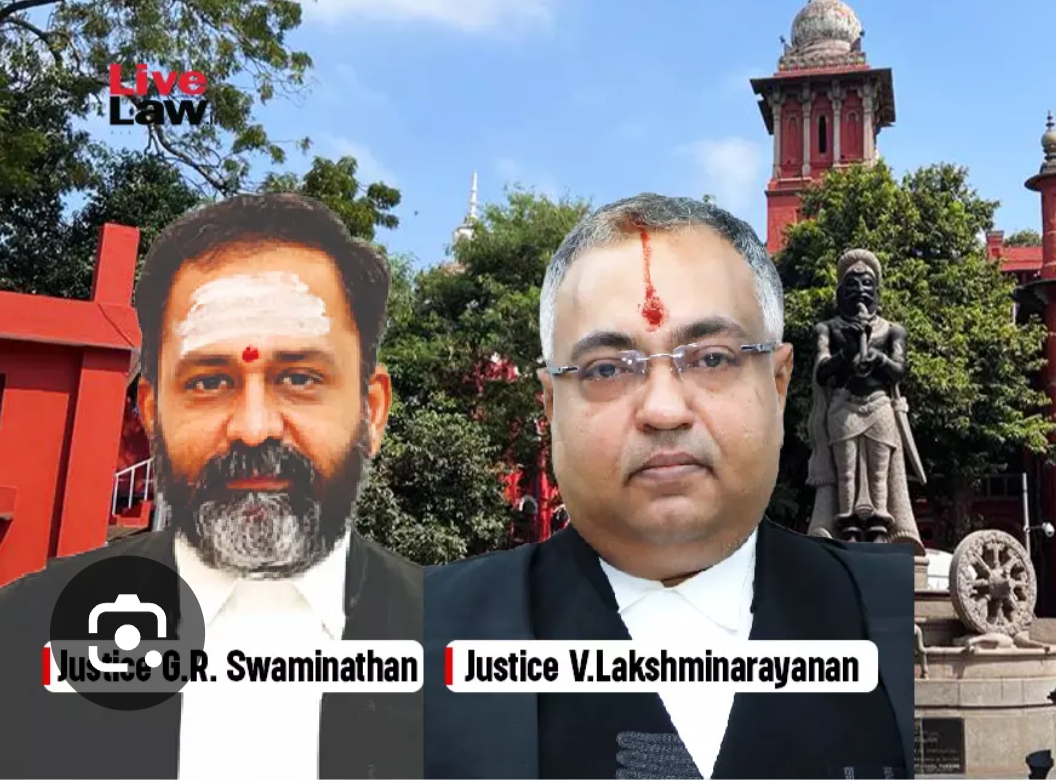 .)
.)
29-05-2026
Index: Yes/No
Speaking/Non-speaking order
Neutral Citation: Yes/No
SKM
To
1. The Inspector of Police,
Ethapur Police Station,
Pethanaickenpalayam Taluk,
Salem District, Tamil Nadu-636 117.
2. The Superintendent of Prison, Salem Central Prison, Hastampatti, Salem-636 007.
3. The Public Prosecutor, High Court, Madras
G.R.Swaminathan, J. and
V.Lakshminarayanan, J.
SKM
Crl.Appeal No.1185 of 2022
29.05.2026