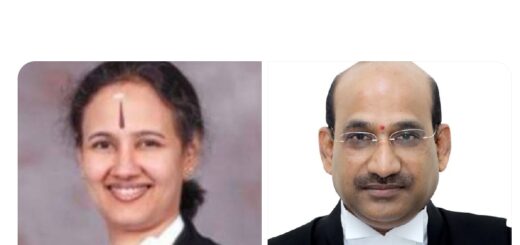
THE HONOURABLE MRS.JUSTICE L.VICTORIA GOWRI Crl.O.P.(MD).No.3555 of 2026 and Crl.M.P.(MD)Nos.3853 and 3854 of 2026 1. A.Nagarajan 2. Agni Bala @ Balasubramanian … Petitioner
BEFORE THE MADURAI BENCH OF MADRAS HIGH COURT
RESERVED ON : 27.02.2026
PRONOUNCED ON : 01.06.2026
CORAM
THE HONOURABLE MRS.JUSTICE L.VICTORIA GOWRI
Crl.O.P.(MD).No.3555 of 2026 and
Crl.M.P.(MD)Nos.3853 and 3854 of 2026
1. A.Nagarajan
2. Agni Bala @ Balasubramanian
… Petitioner
Vs.
The State of Tamilnadu
Rep. by, the Inspector of Police, Karaikudi North Police Station, Sivagangai District.
Crime No. 381/2024
… Respondent
Prayer : Criminal Original Petition is filed under Section 528 of BNSS, 2023, to call for the records relating to the Charge Sheet in S.T.C.No.1132 of 2025 on the file of the learned Judicial Magistrate,
Karaikudi and quash the same.
For Petitioner : Mr.K.Kharikharadas
For Respondent : Mr.S.Ravi,
Additional Public Prosecutor
ORDER
The present Criminal Original Petition requires this Court to examine whether the materials placed in the final report, even if accepted at their face value, disclose the essential ingredients of Sections 196(1)(a) and 353(2) of the Bharatiya Nyaya Sanhita, 2023, and whether the continuation of S.T.C.No.1132 of 2025 would amount to a legitimate prosecution or an abuse of the process of Court.
Case of the Prosecution:
2. The prosecution case, in brief, is that on 09.09.2024, at about 6.00 p.m., the first petitioner, stated to be the Karaikudi District Secretary of the Bharatiya Janata Party, and the second petitioner, stated to be the Karaikudi District Secretary of Hindu Munnani, participated in a public meeting. It is alleged that in the said meeting, the petitioners spoke against persons belonging to the Islamic community and that the said speech was made with an intention to create disharmony between religious groups and to incite public disturbance and riot.
3. Based on the complaint of a Sub-Inspector of Police, therespondent police registered a case in Crime No.381 of 2024, dated 20.09.2024, for the alleged offences under Sections 196(1)(a) and 353(2) of the Bharatiya Nyaya Sanhita, 2023. After investigation, the respondent police filed a final report, which was taken on file as S.T.C.No.1132 of 2025 by the learned Judicial Magistrate, Karaikudi.
Grounds for Quash:
4. The petitioners contend that the final report is legally unsustainable and factually infirm, as the basic ingredients of Sections 196(1)(a) and 353(2) BNS are absent. It is their specific case that the entire prosecution rests only upon police witnesses. The complainant is a Sub-Inspector of Police and all the three witnesses cited in the final report are police officials attached to the very same police station. No independent public witness has been examined and no member of the allegedly affected community has lodged any complaint.
5. The petitioners further contend that mere political criticismor expression of opinion in a public meeting cannot be criminalised unless the speech has a direct and proximate tendency to incite violence, create hatred or disturb public tranquillity. It is also contended that the final report does not reproduce the exact words allegedly spoken by the petitioners. In the absence of the actual speech, its context, its audience, its effect and its proximate consequence, the prosecution cannot proceed on vague and omnibus allegations.
6. The petitioners would further submit that no material has been produced to show that the alleged speech resulted in communal disharmony, public disturbance, violence, riot, breach of peace or any law-and-order situation.
7. The petitioners also rely upon the principle laid down in State of Haryana v. Bhajan Lal1, and contend that even if the allegations are taken at their face value, no offence is made out and the proceedings are manifestly attended with mala fides.
1 1992 Supp(1) SCC 335
8. Heard the learned counsels on either side and carefullyperused the materials available on record.
Point for Consideration:
9. The point that arises for consideration is whether the final report in S.T.C.No.1132 of 2025 on the file of the learned Judicial Magistrate, Karaikudi, arising out of Crime No.381 of 2024, discloses the essential ingredients of Sections 196(1)(a) and 353(2) BNS and whether the continuation of the said proceedings would amount to abuse of process of law?
Analysis:
10. The inherent power of this Court under Section 528 BNSS is intended to prevent abuse of the process of any Court and to secure the ends of justice. While exercising such jurisdiction, this Court does not conduct a meticulous trial or weigh the evidence as an appellate Court. However, where the allegations, even if taken at their face value, do not constitute the alleged offences, this Court is not powerless to interdict the prosecution.
11. In State of Haryana v. Bhajan Lal2, the Hon’ble Supreme Court has held that criminal proceedings may be quashed where the allegations in the FIR or complaint, even if accepted in their entirety, do not prima facie constitute any offence, or where the proceedings are manifestly attended with mala fides or instituted with an ulterior motive.
12. In prosecutions relating to speech offences, the Court must examine not merely whether the speech is unpleasant, objectionable or politically sharp, but whether it crosses the statutory threshold of promoting enmity, hatred or ill-will, or whether it has a proximate tendency to disturb public order.
13. Section 196(1)(a) BNS penalises promotion of enmity between different groups on grounds such as religion, race, place of birth, residence, language, caste or community, or doing acts prejudicial to the maintenance of harmony. The essential ingredients of Section 196(1)(a) BNS are:
i. there must be words, signs, visible representations or other acts;
2 1992 Supp(1) SCC 335
ii. such words or acts must promote or attempt to promote enmity, hatred or ill-will between different groups; iii. the promotion must be on grounds such as religion, race, language, caste, community or similar identity-based grounds; iv. there must be a clear tendency to disturb public harmony or tranquillity; and
v. the allegations must disclose the substance, context and effect of the offending speech.
14. In the present case, the final report states only that the petitioners spoke against Islamic people in a public meeting and that such speech was made with an intention to create disharmony. However, the actual words allegedly spoken by the petitioners have not been extracted. The final report does not disclose the exact contents of the speech, the context in which it was made, the persons who heard it, the immediate reaction of the audience or any consequent breach of peace.
15. A bald allegation that a speech was made against aparticular community, without reproduction of the offending words or without any material showing its tendency to promote enmity, cannot satisfy the statutory requirement of Section 196(1)(a) BNS. The prosecution has not placed any material to show that the alleged speech caused communal disharmony, led to public disorder, triggered violence or disturbed public tranquillity. There is no complaint from any member of the public or from any person belonging to the allegedly affected community.
16. The mere fact that the petitioners belong to political or religious organisations cannot by itself lead to a presumption of criminal intent. Political speech may be critical, harsh or provocative in the ordinary sense of public debate. But criminality under Section 196(1)(a) BNS arises only when the statutory element of promotion of enmity or hatred between groups is clearly disclosed. In the absence of the precise speech and in the absence of any proximate material showing promotion of enmity, this Court is of the considered view that the offence under Section 196(1)(a) BNS is not made out.
17. Section 353 BNS deals with statements conducing to public mischief. Sub-section (2) concerns making, publishing or circulating any statement, false information, rumour or alarming news, including through electronic means, with intent to create or promote, or which is likely to create or promote, feelings of enmity, hatred or ill-will between different groups. The essential requirements of Section 353(2) BNS are:
i. making, publishing or circulating a statement, false information, rumour or alarming news; ii. such statement must be capable of creating or promoting enmity, hatred or ill-will between different groups; iii. the intention or likelihood contemplated by the section must be apparent from the material collected; and iv. the prosecution must disclose what statement was made, published or circulated.
18. In the present case, there is no material to show publication or circulation of any false information, rumour or alarming news. The allegation is only that the petitioners made a speech in a public meeting. Even the contents of the alleged speech have not been set out in the final report.
19. For invoking Section 353(2) BNS, the prosecution must disclose the statement which is alleged to be false, alarming or mischievous. Without placing the alleged statement before the Court, the prosecution cannot invite the Court to presume that the words used by the petitioners would fall within the mischief of Section 353(2) BNS.
20. The final report does not disclose any material showing that the alleged speech was circulated, published or electronically transmitted so as to create public mischief. Nor does it disclose any public reaction, communal tension or law-and-order consequence. Therefore, this Court finds that the offence under Section 353(2) BNS is also not made out.
21. The complainant in the present case is a Sub-Inspector of Police. The witnesses cited in the final report are also police officials.
It is true that the testimony of police witnesses cannot be rejected merely on the ground that they are police personnel. However, where the allegation relates to a public meeting and an alleged speech addressed to members of the public, the total absence of any independent witness assumes significance at the stage of examining whether the prosecution has the minimum factual foundation to proceed.
22. No member of the public has complained. No person from the allegedly affected community has stated that the speech caused hatred, fear, disharmony or resentment. No material has been collected to show any disturbance following the alleged meeting. The absence of independent material, when seen along with the vague nature of the allegations and the non-production of the actual speech, substantially weakens the prosecution case at its very threshold.
23. An additional and substantial legal infirmity is also seen in the present prosecution. Section 217 BNSS imposes a restriction on the Court taking cognizance of certain offences without previous sanction. Under Section 217(1) BNSS, no Court shall take cognizance of any offence punishable under Section 196 BNS except with the previous sanction of the Central Government or the State Government and no Court shall take cognizance of any offence punishable under Section 353(2) BNS except with the previous sanction of the Central Government, the State Government or the District Magistrate.
24. The object of such sanction is not to protect offenders, but to ensure that prosecutions relating to public speech, communal harmony and public order are not launched casually, mechanically or for collateral purposes. In the present case, the materials placed before this Court do not disclose that previous sanction, as mandated under Section 217 BNSS, was obtained before cognizance was taken by the learned Judicial Magistrate, Karaikudi. When the statute expressly bars cognizance except with previous sanction, the absence of sanction goes to the root of the matter. The cognizance taken in S.T.C.No.1132 of 2025 is therefore vitiated.
25. This Court is conscious that speeches having the tendencyto promote communal hatred must be dealt with sternly. The secular fabric of the Constitution cannot be permitted to be torn by calculated hate speech. However, every political criticism or every speech containing sharp ideological expression cannot be straightaway converted into a criminal prosecution unless the statutory ingredients are clearly disclosed.
26. Criminal law cannot be set in motion on vague apprehensions. The prosecution must disclose the exact statement, its context, its tendency, its public impact and the legal ingredients of the offence. In the absence of such foundational material, the continuation of prosecution would amount to compelling the accused to face the ordeal of trial without a legally sustainable accusation.
27. The present case, viewed in its entirety, appears to rest on a vague allegation, unsupported by independent public material, without reproduction of the offending words, without proof of public disorder and without statutory sanction. Therefore, this Court has no hesitation in holding that the continuation of S.T.C.No.1132 of 2025 would amount to abuse of process of law.
Epilogue:
28. The criminal Court is not a theatre for political rivalry. Nor is it an instrument to sterilise public speech merely because such speech may be inconvenient, disagreeable or ideologically opposed to another point of view. The majesty of criminal law lies in its disciplined invocation. When invoked without the indispensable statutory foundation, it ceases to be an instrument of justice and becomes an instrument of oppression.
29. Communal harmony is undoubtedly a constitutional value of high order. But the protection of communal harmony cannot be achieved by prosecutions founded on vague allegations. It must rest on precise facts, lawful procedure and scrupulous adherence to statutory safeguards. The Constitution protects both social peace and individual liberty. The Court must ensure that neither is sacrificed at the altar of expediency.
30. In the case on hand, the final report does not disclose thewords spoken, the public mischief caused, the enmity promoted, the disturbance created or the sanction obtained. What remains is only a bare allegation. A criminal trial cannot be permitted to proceed on such an uncertain and infirm foundation.
31. In the result, this Criminal Original Petition is allowed. The proceedings in S.T.C.No.1132 of 2025 on the file of the learned Judicial Magistrate, Karaikudi, arising out of Crime No.381 of 2024 on the file of the respondent police, for the alleged offences under Sections 196(1)(a) and 353(2) of the Bharatiya Nyaya Sanhita, 2023, are hereby quashed. Consequently, connected miscellaneous petitions are closed. The appearance of the petitioners before the learned Judicial Magistrate, Karaikudi, stands dispensed with.
01.06.2026
NCC : Yes / No
Index : Yes / No
Internet : Yes/ No
Sml
To
1. The Inspector of Police, Karaikudi North Police Station, Sivagangai District.
2. The Additional Public Prosecutor, Madurai Bench of Madras High Court, Madurai.
L.VICTORIA GOWRI, J.
Sml
CRL OP(MD)No.3555 of 2026
01.06.2026