The Madras High Court comprising of Hon’ble Chief Justice MM Shrivatsava and Hon’ble Justice Arulmurugan is closely examining the Election Commission of India’s purported authority to “delist” political parties, raising constitutional concerns about the Commission’s lack of statutory authority and the potential impact on political participation and democratic freedoms.

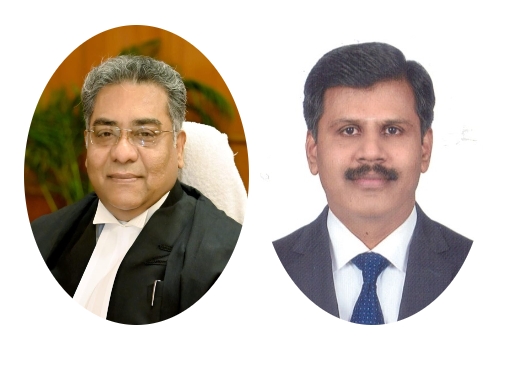

 Article 324 Is Not a Blank Cheque”: Madras High Court Examines ECI’s Claimed Power to Delist Parties
Madras High Court — Writ Jurisdiction — Article 226 — Election Commission of India — Political Parties — Delisting — Absence of Statutory Power
The Madras High Court comprising of Hon’ble Chief Justice MM Shrivatsava and Hon’ble Justice Arulmurugan is closely examining the Election Commission of India’s purported authority to “delist” political parties, raising constitutional concerns about the Commission’s lack of statutory authority and the potential impact on political participation and democratic freedoms. The case arises after a group of political parties filed a writ petition under Article 226, arguing that a show-cause notice suggesting its delisting was arbitrary, unconstitutional, and outside the Commission’s jurisdiction. The petitioners were represented by Senior Advocates S. Prabakaran, Wilson and N L Raja.
The petitioner Senior Counsels argued that “delisting” is not allowed by law because the Representation of the People Act of 1951 or any other law does not give the Election Commission the power to do so. They contended that dependence on Article 324 would unlawfully augment constitutional authority, in a context where Parliament has intentionally refrained from legislating. Senior Counsel Prabakaran argued that delisting is a colourable exercise that is the same as deregistration, which the Supreme Court has said the Commission cannot do, the Senior Counsel referred the Law Commission’s 2015 recommendation for Section 29R and Parliament’s decision not to enact it as proof of legislative intent. He further argued that delisting’s consequences, including loss of legal recognition and electoral entitlements, are indistinguishable from deregistration and thus unconstitutional without statutory authority.
The petitioners challenged the Show Cause Notice, stating that they had submitted their written representation to the Election Commission on 25 August 2025 within the deadline. They contended that the allegation of not contesting elections for six years was incorrect, as official records show their participation rendering the proposed delisting arbitrary and unsustainable.
The petitioners senior Counsel Wilson and Prabakaran criticised the proceedings as mechanical and lacking application of mind, noting that their inclusion among 474 parties indicated a blanket, automated exercise rather than an individual assessment. The action ignored the petitioner’s explanations and evidence, violating principles of natural justice. The learned senior counsel appearing for the petitioners, submitted that the party had actively contested elections, including the upcoming one, as well as previous general, state, and local body elections, often in alliance, and contended that the Election Commission of India, with malafide intent, delisted the party on a frivolous ground of non-participation over the past six years. They emphasized that the ECI’s order was mechanical and arbitrary, ignored the party’s representations, and would have serious civil and democratic consequences, including denial of statutory benefits and loss of entitlement to a common symbol under the Election Symbols (Reservation and Allotment) Order, 1968, effectively erasing the party’s political identity. The learned counsel also adopted the arguments advanced by the learned senior counsels Prabhakaran and Wilson.
Senior Counsel Wilson argued that political parties are associations protected under Article 19(1)(c), and any restriction on their existence or functioning requires legislation under Article 19(4); without such law, the proposed delisting directly infringes fundamental rights.
Senior Counsel Prabakaran submitted that judicial review remains fully maintainable despite Article 329 when the action is unconstitutional, arbitrary, or without jurisdiction. The petitioner also objected to new grounds raised in the counter-affidavit, including treating participation through alliances or shared symbols as non-contestation. It was contended that the ECI cannot use plenary powers as abuse of process of law and that the said power is also subject to judicial review. The Hon’ble court had adjourned the matter to Tuesday for further hearing.