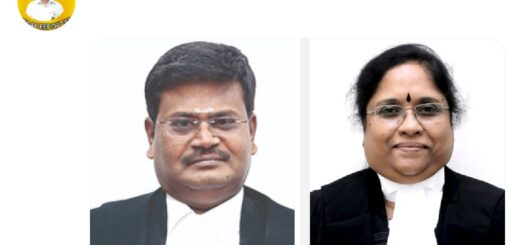
THE HONOURABLE MR.JUSTICE C.V. KARTHIKEYAN and THE HONOURABLE MR.JUSTICE R.SAKTHIVEL W.P.(MD)Nos.19539, 19658 and 20653 of 2026 and W.M.P.(MD)No.14536 of 2026 W.P.(MD)No.19539 of 2026:- Theeran Thirumurugan @ Thirumurugan … Petitioner vs. 1.The Chief Secretary, Government of Tamil Nadu, Secretariat, Chennai 600 009. 2.The Additional Chief Secretary, Human Resources Management Department, Government of Tamil Nadu, Secretariat, Chennai 600 009. 3.The Secretary, Personnel and Administrative Reforms Department, Government of
2026:MHC:3139
BEFORE THE MADURAI BENCH OF MADRAS HIGH COURT
DATED: 27.07.2026
CORAM
THE HONOURABLE MR.JUSTICE C.V. KARTHIKEYAN and
THE HONOURABLE MR.JUSTICE R.SAKTHIVEL
W.P.(MD)Nos.19539, 19658 and 20653 of 2026 and
W.M.P.(MD)No.14536 of 2026
W.P.(MD)No.19539 of 2026:-
Theeran Thirumurugan @ Thirumurugan … Petitioner
vs.
1.The Chief Secretary,
Government of Tamil Nadu, Secretariat, Chennai 600 009.
2.The Additional Chief Secretary,
Human Resources Management Department, Government of Tamil Nadu, Secretariat, Chennai 600 009.
3.The Secretary,
Personnel and Administrative Reforms Department, Government of Tamil Nadu, Secretariat, Chennai 600 009.
4.The Secretary,
Home Department,
Government of Tamil Nadu,
Secretariat, Chennai 600 009.
5.The Secretary,
Revenue and Disaster Management Department, Government of Tamil Nadu, Secretariat, Chennai 600 009.
6.The District Collector,
Karur District, Collectorate, Karur.
7.The Member Secretary,
Tamil Nadu Public Service Commission,
TNPSC Road, V.O.C. Nagar, Park Town,
Chennai, Tamil Nadu, India – 600 003. … Respondents
(The 7th respondent was suo motu impleaded vide order of this Court, dated 10.07.2026)
PRAYER: Writ Petition filed under Article 226 of the Constitution of India for issuance of Writ of Mandamus, to direct the respondents 1 – 6 to forbear from issuing or implementing any Government appointment orders arising out of the Karur stampede incident until the proceedings pending before the Hon’ble Supreme Court in relation to the said incident attain finality.
For Petitioner :Mr.W.Cleetus
For R1 to R6 :Mr.Vijay Narayan Advocate General
assisted by Mr.M.P.Senthil Counsel for State of Tamil Nadu and Mr.Akash Srinandha
For R7 :Mr.P.V.Balasubramanian Additional Advocate General assisted by Mr.J.Anand Kumar
W.P(MD)No.19658 of 2026:-
Seeni Ahamed … Petitioner
vs.
1.The Chief Secretary,
Government of Tamil Nadu,
Secretariat, Fort St. George, Chennai 600 009.
2.The Additional Chief Secretary to Government,
Personnel and Administrative Reforms Department,
Secretariat, Fort St. George, Chennai 600 009.
3.The Secretary,
Tamil Nadu Public Service Commission, TNPSC Road, V.O.C.Nagar, Park Town, Chennai- 600 003, Tamil Nadu, India.
4.The Directorate of Employment and Training (DET),
Commissionarate of Employment and Training, Thiru. Vi. Ka. Industrial Estate,
Alandur Road, Guindy, Chennai 600 032.
5.The Director, CBI,
Central Bureau of Investigation, Chennai Zonal Office, Chennai.
6.The Superintendent of CBI,
O/o. Superintendent of CBI,
3rd Floor, Shastri Bhawan, No. 26,
Haddows Road, Nungambakkam, Chennai.
7.The Inspector of Police,
Karur Town Police Station, Karur District.
8.N.Anand,
General Secretary,
The Party Headquarters,
Tamilaga Vettri Kazhagam (TVK),
8th Avenue, Panaiyur, Chennai,
Tamil Nadu-600 119. … Respondents
PRAYER: Writ Petition filed under Article 226 of the Constitution of India for issuance of Writ of Mandamus, to restrain the respondent Nos.1 to 3 from giving effect to the proposed scheme of granting Government employment to the family members of the deceased victims of the Karur stampede (Crime No.855 of 2025) now the file of Respondent No.6 and consequently direct respondents 5 and 6 to examine and report to this Court whether the proposed conferment of Government employment on the said families is capable of affecting the fairness of the ongoing investigation and to take such steps as may be warranted in law.
For Petitioner :Mr.S.M.A.Jinnah, for Mr.A.Mohammed Rashid
For R1, R2 and R4:Mr.Vijay Narayan Advocate General assisted by Mr.M.P.Senthil Counsel for State of Tamil Nadu and Mr.Akash Srinandha
For R3 :Mr.P.V.Balasubramanian
Additional Advocate General assisted by Mr.J.Anand Kumar For R5 and R6 :Mr.N.Mohideen Basha
Special Public Prosecutor for CBI
For R7 :Mr.S.Arun Arockiasamy
Government Advocate (crl.side)
W.P(MD)No.20653 of 2026:-
P.Santhosh Kumar … Petitioner
vs.
1.The State Rep. by its Principal Secretary,
Home Department,
Government of Tamil Nadu,
Secretariat, Fort St.George, Chennai-600 009.
2.The State Rep. by its Principal Secretary,
Human Resources Management Department, Government of Tamil Nadu, Fort St.George, Chennai-600 009.
3.The District Collector,
Office of the District Collector,
Karur, Karur District. … Respondents
PRAYER: Writ Petition filed under Article 226 of the Constitution of India for issuance of Writ of Mandamus, to direct the respondents to refrain from issuing any Government Order or taking any administrative action granting public Government employment to the next of kin of the 41 deceased persons in the Velusamypuram, Karur District, stampede incident, as any such action would be contrary to Articles 14 and 16 of the Constitution of India and principles of merit based requirement by the way of considering the petitioner’s representation dated 08.07.2026 in accordance with law within the time stipulated by this Court.
For Petitioner :Mr.R.Rajaselvan
For Respondents :Mr.Vijay Narayan Advocate General assisted by Mr.M.P.Senthil Counsel for State of Tamil Nadu and Mr.Akash Srinandha
*****
COMMON ORDER
(Order of the Court was made by C.V.KARTHIKEYAN, J.)
All the three Writ Petitions have been filed in the nature of a Mandamus as a Public Interest Litigation seeking restraint against the respondents from issuing any Government Order or taking any administrative action granting public appointment or Government appointment for the family members of the victims of what is commonly called Karur stampede incident.
2.It had been stated that grant of such employment would be directly in violation of the stipulations, as provided under Articles 14 and 16 of the Constitution of India. It had also been stated that the issue relating to Karur stampede is pending before the Hon’ble Supreme Court and the investigation has been transferred to the Central Bureau of Investigation and is monitored by a former Judge of the Hon’ble Supreme Court. It had been stated that when the situation is nascent and still live and no definite conclusion had been reached as to the manner in which the Karur stampede took place, it was not proper on the part of the Government to extend succor to the family members of the victims by offering them Government/public appointments.
3.The first Writ Petition is W.P.(MD)No.19539 of 2026. The records show that it was filed on 08.07.2026 in the nature of a Mandamus. The Government had, however, passed G.O.Ms.No.544, Revenue and Disaster Management (Ser-9) Department on 06.07.2026 granting appointments to 32 named individuals. It had been stated that this order had been passed or rather these public appointments had been done on compassionate grounds after taking into note the tragedy which had occurred leading to the death of 41 unfortunate individuals. It had also been stated that the Government had taken note of the reports of the District Collectors of Karur, Erode, Tirupur, Dindigul and Salem and also the Additional Chief Secretary/Revenue Secretary of the Government, who had also given their recommendations and accordingly, a decision had been taken to grant public appointments to the said named
individuals.
4.The Writ Petitions came up for admission on 10.07.2026. It was informed that on that very day in the afternoon, a function was to be held, wherein, appointment orders were scheduled to be handed over to the beneficiaries at around 03.00 pm. It was also contented that an intervening application had been filed before the Hon’ble Supreme Court in I.A.No.187811 of 2026 and one of the specific grounds taken was the Government had come forward to grant compassionate appointment, when ex gratia assistance had already been granted to them. However, when the matter was actually heard by the Hon’ble Supreme Court, the intervening application was withdrawn with liberty to pursue such other remedy as the petitioner therein thought fit or was available to the petitioner therein. Taking into consideration the facts, at that juncture, we had expressed that it would have been extremely narrow to intervene or put a halt to a function during which the said appointment orders were to be issued. We had however made it very clear that the function is being permitted to proceed further only on the condition that the employments would be on temporary basis and subject to judicial review. We had also expressed our opinion that we should be put in a position to hear the matters before the prospective individuals to whom employment had been offered receive their first salary. We had permitted the function to proceed on that condition.
5.We must express our deep gratitude to all the members across the
Bar, to the learned Advocate General, to the learned Additional Advocate General and to all the assisting Government Counsels and also to the learned Counsels for the petitioners who finalised the pleadings and presented us with adequate assistance to enable us to deliver this order before those who had been offered employment had actually received
their first salary.
6.One of the issues which had been taken up by the learned Advocate General was the maintainability of these Writ Petitions. He questioned the maintainability on two grounds;
1)That a Public Interest Litigation would not be maintainable questioning public employment or rather in service matters; and
2)That a Writ of Mandamus could not be maintained in the teeth of a Government Order having been passed and the relief of Certiorari not being asked.
7.With respect to the second issue, namely, the permissibility of the Court to traverse beyond the relief which had been sought, we are deeply conscious of the judgement of the Hon’ble Supreme Court reported in 2010 (1) SCC 234 [Bharat Amratlal Kothari -vs.- Dosukhan Samadkhan Sindhi] wherein, in an entirely different context and in relation to a criminal matter, the Hon’ble Supreme Court examined the order of a High Court of Gujarat at Ahmedabad in a Writ Petition under Article 226, when the Court was not exercising authority suo motu but examined the validity of the order of a trial Court and granted reliefs which were not sought by the Writ Petitioner. It was held that it was not proper. The Hon’ble Supreme Court had held that the provisions of the Code of Civil Procedure would not normally apply to Writ Petitions, but general principles thereof would apply to Writ Petitions. It was, therefore, held that the Writ Petitioner must claim all reliefs he seeks as the Court would normally grant only the reliefs specifically sought.
8.In that particular case, where, pursuant to a First Information Report registered against drivers and cleaners of lorries for committing cruelty against animals transported in trucks and the Police had seized the animals and had placed them in a Pinjrapole, the animal owners had filed an application seeking release of animals. That application had been rejected by the trial Court. They filed Writ Petition questioning such rejection. The High Court had issued a direction granting compensation and costs against the informant. This order was held to be improper by the Hon’ble Supreme Court.
9.The Hon’ble Supreme Court while examining the correctness of a judgement of the Division Bench of the Himachal Pradesh High Court in a judgment reported in 2026 SCC OnLine SC 1319 [Union of India and others -vs.- Bali Ram], had held at para 37 that the rule that requires the parties to be strictly confined to the pleadings and the prayer clauses is not an inflexible rule in so far as exercise of Writ jurisdiction is concerned. Para 37 of the said judgment is as follows:
“37.However, the rule that requires the parties to be strictly confined to the pleadings and the prayer clauses is not an inflexible rule insofar as exercise of writ jurisdiction is concerned.”
10.It would only indicate that while exercising Writ jurisdiction, a flexible rule could be adopted by the Court to a limited extent. The Hon’ble Supreme Court explained this particular observation further in para 38, which reads as follows:
“38.Justice is a virtue which transcends all barriers. Neither the rules of procedure nor technicalities of law can stand in its way. Even the law bends before justice. The entire concept of writ jurisdiction exercised by the higher courts is founded on equity and fairness (S. Nagaraj v. State of Karnataka [1993 Supp (4) SCC 595]).”
11.In S.Nagaraj (referred supra) which, incidentally, also related to service law, the Hon’ble Supreme Court held that justice is a virtue which transcends all barriers. Neither the rules of procedure nor technicalities of law can stand in its way.
12.With respect to the expanding scope of exercise of jurisdiction in Article 226 of the Constitution of India, the Hon’ble Supreme Court placed reliance on an earlier judgment of the Hon’ble Supreme Court reported in AIR 1966 SC 81 [Dwarka Nath -vs.- Income Tax Officer]. In para 39, it had been held by the Hon’ble Supreme Court as follows:
“39.Ex facie, Article 226 which is couched in comprehensive phraseology confers wide power on the high courts to reach injustice wherever it is found. Apart from writs, the high courts may issue orders or directions in the nature of writs enabling them to mould the reliefs to meet the peculiar and complicated requirements of this country (see: Dwarka Nath v ITO [AIR 1966 SC 81).”
13.While referring to Dwarka Nath, referred supra, a Three
Judges Bench of the Hon’ble Supreme Court held that Article 226 of Constitution of India is couched in comprehensive phraseology and it ex facie confers a wide power on the High Court to reach injustice wherever it is found.
14.Further, reliance had been made in paragraph No.40 to the judgment of the Hon’ble Supreme Court reported in (2004) 3 SCC 553 [ABL International Limited -vs.- Export Credit Guarantee Corporation of India]. The Hon’ble Supreme Court while relying on the
aforementioned judgement had held as follows:
“40.Article 226 confers a power that is plenary, equitable and discretionary, and is not one bound by the rigidities of law. Even in the contractual field, an arbitrary State action could be liable to judicial review (see: ABL
International Ltd. v Export Credit Guarantee Corporation of India21).”
15.It had even expanded the scope of judicial review to contractual field as against an arbitrary State action.
16.In view of the said pronouncements, we are of the considered opinion that the issue of maintainability of these Writ Petitions on the ground that they have not questioned the Government Order passed would not lie, not only owing to the power of this Court while exercising extraordinary original jurisdiction under Article 226 of the Constitution of India, but also because we had made it very clear at the time of the first hearing that the appointments would certainly be subjected to judicial review. We would exercise our power to treat this Writ as a Certiorari examining the order passed by the Government.
17.The learned Advocate General had raised another question of maintainability on the ground that a Public Interest Litigations cannot and should not be entertained, while questioning service matters or public appointments. In this connection, the learned Advocate General had placed reliance on a catena of judgments, all of which flowed from the reasoning given in the judgment of the Hon’ble Supreme Court reported in (1998) 7 SCC 273 [Dr.Duryodhan Sahu and others -vs.- Jitendra Kumar Mishra and others]. Specific reliance was placed on paragraph No.21 of the said judgment but however, we would first
extract the facts of the case.
18.1.The petitioner therein was a qualified Surgeon with Postgraduate Degree in General Surgery and was working in the Department of Gastroenterology in the Medical College at Cuttack as Assistant Surgeon. He had also worked as Lecturer in General Surgery for a considerable period of time. He was also assisting the Professor and Head of Department of Surgical Gastroenterology for about five years and had also obtained special training/experience in the said subject. The Orissa Public Service Commission had caused an advertisement for
Junior Teacher (Lecturer) in several disciplines including Surgical Gastroenterology. The petitioner, with all these experience backing him, had applied for the said post.
18.2.The case of the petitioner and that of another individual had been referred to the Public Service Commission for their opinion on their eligibility for selection. The other individual was recommended to the Government and he was appointed as Junior Teacher. Thereafter, the matter moved before the Central Administrative Tribunal with each candidate projecting that they should have been appointed and not the other. It was under those circumstances, against the order of the Administrative Tribunal, the matter finally reached before the Hon’ble
Supreme Court.
19.It was held that the Administrative Tribunal cannot entertain a Public Interest Litigation at the instance of a total stranger. Thereafter, after holding thus, the Hon’ble Supreme Court examined the specific case of the appellant before it and held that it was not necessary to hold whether the case of the appellant was bona fide and whether the other applicants had ulterior motives. Finally, the judgement of the Orissa Administrative Tribunal was set aside. It was under those circumstances, the jurisprudence arose that Public Interest Litigations would not lie against service matters.
20.The learned Advocate General, had, as stated, relied on a series of judgments. The second judgment which he had relied on was the one reported in (2005) 1 SCC 590 [Dattaraj Nathuji Thaware -vs.- State of Maharashtra]. The appellant therein, a Lawyer, was caught red-handed blackmailing respondents 6 and 7 and accepting blackmailing money. It was under those circumstances that the High Court found that no public interest was involved and dismissed the said petition filed by the Lawyer, who had indulged in blackmailing respondents 6 and 7. The High Court imposed cost of Rs.25,000/- and directed the cost to be paid to the respondents 6 and 7. The matter reached the Hon’ble Supreme Court. The Hon’ble Supreme Court stated that the duty of the Court was to redress only genuine public wrongs or injury and public interest litigations are not to be used for redressal of private, publicity oriented or political disputes or other disputes not genuinely concerned with public interest. The facts herein are certainly distinguishable.
21.The third judgment, which the learned Advocate General relied on was the one reported in (2007) 10 SCC 614 [Neetu -vs.-State of Punjab]. The challenge before the Hon’ble Supreme Court was to an order of a Division Bench of the Punjab and Haryana High Court. The respondents 1 to 6 were official respondents in the Writ Petition. The appellant was appointed as Audit Inspector in the Cooperative Societies on the basis of a Scheduled Caste certificate, though she was not a member of the Scheduled Caste. She had married a member of the Scheduled Caste. She therefore claimed that she should be granted that particular benefit. On this issue, the Hon’ble Supreme Court, on the said facts, held that a Public Interest Litigation was not maintainable and found that the Writ Petition had been filed owing to personal animosity.
Again, the facts are distinguishable.
22.The next judgment relied on by the learned Advocate General was the one reported in (2013) 4 SCC 465 [Ayaaubkhan Noorkhan Pathan -vs.- State of Maharashtra and others] where again, the caste certificates as Scheduled Caste, Scheduled Tribe, OBC and Minorities and Tribe certificates had been validated by the Scrutiny Committee and caste verification certificates had been granted. This was challenged. The Hon’ble Supreme Court held that the locus to challenge such certificates issued by the Scrutiny Committee will have to be and should be examined by the High Court and therefore, had imposed cost of Rs.1,00,000/- and also directed the same to be recovered as arrears of land revenue. The facts again are distinguishable.
23.The further judgment relied on by the learned Advocate General was the one reported in (2020) 18 SCC 673 [Vishal Ashok Thorat and others -vs.- Rajesh Srirambapu and others] which was with respect to recruitment process and a selection list published and the interference of the selection list by the Court without permitting challenge to the advertisements pursuant to which the selection list had been prepared. The Hon’ble Supreme Court observed upon the unsustainability of such challenge. It was also stated that challenge by those who did not participate in the selection process and who are not permitted to challenge the advertisements cannot maintain a Writ Petition. The facts are again distinguishable.
24.The learned Advocate General had also placed reliance on a judgment of Hon’ble Supreme Court reported in (2021) SCC 534 [State of Tamil Nadu and another -vs.- National South Indian River Interlinking Agriculturalists Association]. The Hon’ble Supreme Court examined an issue when the State Government extended waiver of loans to small and marginal farmers. The Hon’ble Supreme Court held that such classification was proper.
25.In the said judgment reference had been made to the definition of a ‘small farmer’ and to the definition of a ‘marginal farmer’. A ‘small farmer’ meant a farmer, who held land of 2.5 acres to 5 acres and a ‘marginal farmer’ meant a farmer who held land up to 2.5 acres. This distinction already existed and it is for them that such waiver was granted. The Hon’ble Supreme Court had further examined in detail the difficulties such farmers faced in para No.23 and therefore, had upheld such classification. Para 23 of the judgment was as follows:
“23.It has been submitted that the consumption expenditure of marginal and small farmers exceeds their estimated income by a substantial margin, and the deficits are covered by borrowings. The fact that 16,94,145 small and marginal farmers have availed of agricultural loans as compared to 3,01,926 farmers belonging to the ‘other category’ testifies that the small and marginal farmers have a significant capital deficit when compared to the rest of the farmers. A huge capital deficit, combined with a reduction in the agricultural income due to water scarcity and crop inundation due to floods has led to financial distress. Small and marginal farmers are resource deficient; they do not have borewells to overcome the drought. These farmers are usually dependent on large farms to access land, water, inputs, credit, technology, and markets. It was found that almost 40% of the irrigated land of large farmers was from canals, while less than 25% of the land of small and marginal farmers was irrigated by canals or borewells and they often resort to renting water from larger landholdings. The output of produce in a small and marginal farm, for instance, paddy would not be sufficient even to feed the small farmer’s family. Thus, a majority of them purchase grains at a subsidized rate from the Public Distribution System (since these farmers fall below the poverty line) so they can sell their produce.”
26.The further two judgements relied on by the learned Advocate
General arose from a Coordinate Division Bench of this Court in the
Principal Bench. The first one was the one reported in 2026 SCC OnLine Mad 4065 [S.Vivek -vs.- Government of Tamil Nadu and others] and the second one was the judgment in W.P.No.18523 of 2026 [M.Balakrishnan -vs.- Union of India and five others]. Incidentally, both the judgments were delivered by the same Division Bench.
27.The first judgment was with respect to an order passed by the first respondent, namely the Secretary to Government, Government of Tamil Nadu, by which the appeals which had been filed by the 11th and 12th respondents had been allowed and the order of the District Collector directing removal from service was set aside. The Writ Petitioner questioned the reversal of the directions of the District Collector by the Secretary to Government. In those circumstances, the Division Bench held that the Writ Petitioner had no locus, particularly, since the matter was in realm of disciplinary proceedings and the Government had a discretion to re-examine the order of the District Collector as a revisional authority and therefore, relying on the earlier judgments cited above by us and by the learned Advocate General, held that a Public Interest Litigation in a service matter could not be maintained.
28.The second judgment was with respect to grant of promotion to
Indian Administrative Service Officers by the State of Tamil Nadu. The Division Bench held that such promotion comes within the executive power of the State and cannot be questioned by way of a Public Interest Litigation. The judgments referred supra had been extracted by the Division Bench to non suit the Writ Petitioner therein.
29.A careful perusal of the facts of the above cases would show that they were specific to a particular individual or to a case of few individuals whose selections were questioned by those who did not participate in the selection process or those who had personal animosity, as was stated in the case relating to the certificate issued as a Scheduled caste member. It was therefore held that Public Interest Litigations in service matters could not be entertained. The case on hand is entirely different.
30.It had been pointed out by the learned Advocate General that one of the Writ Petitions had been filed by an Advocate. The learned Advocate General wondered whether the Advocate aspired for the post of Office Assistant. However, the other two Writ Petitions have been filed by individuals representing specific Associations.
31.We are not able to express any opinion whether the Advocate, who is one of the Writ Petitioners wanted to be appointed as an Office Assistant. But, however, it is clear that the Writ Petitioners have come to Court with a larger cause. They claim that the Government had come forward to grant appointments to individuals from families who died in Karur stampede and they claim as to why such families also should be granted such public employment, particularly when, in an earlier Government order, ex gratia of Rs.10,00,000/- had been paid to them. They also seek the specific circumstance which singled out the Karur stampede for public employment to be handed over to a member of the family of those who had died during the stampede.
32.The Government has justified grant of such employment on the basis of four earlier instances. The Government Orders relating to the same had also been presented by the learned Advocate General.
33.The first was grant of compassionate appointment to the family of disabled/deceased defence personnel by G.O.Ms.No.1218, dated 03.09.1999. A perusal of the said Government Order shows that dependents, namely, son/unmarried daughters/widows/near relatives, who would take care of the family of the defence service personnel, who are killed/disabled in action and who died in harness should be appointed to a post which fell outside the purview of Tamil Nadu Public Service Commission.
34.We wonder whether an army personal, who dies on the war front for the cause of the nation protecting this country and to ensure that the freedom which has been earned was preserved, could be equated to a member of a family who died in the Karur stampede. We are not stating that the members of the families who died in Karur stampede require less consideration. We have our full sympathy for them, but, we also ought to take note of the fact that fallen war heroes stand on a separate footing and some respect should be shown by everybody for the sacrifice they had made.
35.The second Government Order which was relied on by the learned Advocate General was G.O.(Ms).No.108, dated 15.02.2006, wherein, compassionate appointment was granted to the daughter of a Councillor of Madurai, one Leelavathi, who had been murdered.
36.In the Government Order, the economic circumstances of the beneficiary, namely, K.Kalavathi was examined by the Government. It was very specifically stated in the Government Order that she was in indigent circumstances. She had studied upto 10th standard. It was found that she satisfied the age rule and educational qualification, as prescribed for the post of Office Assistant. It was under those circumstances, she was granted employment. In fact, in the very first paragraph, it had been stated that the Chief Minister had taken a decision to so grant the employment, since the family was suffering very much to meet both ends. Thus, it was again specific to that particular individual and the indigent circumstances in which that family was suffering.
37.In the Government order in G.O.(Ms).No.544, which is examined these Writ Petitions under which 32 individuals had been granted public employment, even though there is reference to the report of the District Collectors and the recommendations made, there is no specific statement made that each one of them was suffering from indigent circumstances and had the necessary educational qualification and were eligible for age relaxation. Their educational qualifications had been given in the Government Order, but we also see that atleast for four separate individuals, age relaxation had been granted.
38.More specifically, the impact of the ex gratia amount of Rs.10,00,000/- which had been earlier granted had also not been stated in the Government Order. It was not stated that in spite of receipt of ex gratia of Rs.10,00,000/-, the families are still suffering and the Government had necessity to extend a helping hand to them. The reason why that Rs.10,00,000/- ex gratia was not sufficient and under what circumstances the families were in penury circumstances again was not stated.
39.We are only stating these facts as we compare the reasons stated while granting employment to the daughter of Leelavathi, Madurai Councillor.
40.The further Government Orders which the learned Advocate
General relied on were G.O.(Ms)No.718, G.O.(Ms)No.723, G.O.(Ms)No.
175, G.O.(Ms)No.594 and G.O.(Ms)No.74, dated 20.09.2018, 25.09.2018, 21.03.2020, 23.11.2020 and 17.05.2021, respectively. All these Government Orders related to grant of public employment for the family members of the victims of those who died in a police shooting at
Thoothukudi in what could be called the Sterlite Agitation.
41.We are also deeply conscious that a Public Interest Litigation had also been filed with respect to providing assistance to the family members of those who died in that particular agitation. The Government has also granted ex gratia. The Government had also granted them employment, but the one distinguishing factor was that the said agitation or the death could be attributed to what could be termed as State excess.
42.We would refrain from stating anything further with respect to Karur stampede, particularly since the matters are still fluid and investigation is still monitored by the Hon’ble Supreme Court.
43.It is also to be noted that ex gratia had also been granted to the members of the victims of Karur stampede vide G.O.(Ms).No.557, dated 08.07.2026.
44.The issue of compassionate appointment is based on specific guidelines. The Hon’ble Supreme Court in Canara Bank -vs.- Ajithkumar G.K., reported in AIR 2025 SC 1232, had extensively dealt with various circumstances under which such compassionate
employment could be granted. It must be first understood that the very concept arose, when a public servant, who discharges duty for and on behalf of the public, dies in harness, leaves his family behind in what could be called an economic death. In those circumstances, in
recognition of his service to the State directly and to the general public indirectly, a member of his family, provided he or she satisfies various conditions and which conditions should be strictly adhered to, is granted public employment.
45.The Hon’ble Supreme Court in the aforesaid judgment had referred to a series of judgments, which had laid down strict guidelines under which compassionate employment could be granted. We would only extract para 11 of the said judgment in which reference has been made to numerous judgments, wherein principles have been laid down for grant of compassionate employment. The principles had been laid down in judgments ranging from A to Z, which would indicate that nearly 26 judgments had been referred by the Hon’ble Supreme Court. We would refer to them:
“11.Decisions of this Court on the contours of appointment on compassionate ground are legion and it would be apt for us to consider certain well-settled principles, which have crystallized through precedents into a rule of law. They are (not in sequential but contextual order):
a) Appointment on compassionate ground, which is offered on humanitarian grounds, is an exception to the rule of equality in the matter of public employment [see General Manager, State Bank of India v. Anju Jain [(2008) 8 SCC 475]].
b) Compassionate appointment cannot be made in the absence of rules or instructions [see Haryana State Electricity Board v. Krishna Devi [(2002) 10 SCC 246]].
c) Compassionate appointment is ordinarily offered in two contingencies carved out as exceptions to the general rule, viz. to meet the sudden crisis occurring in a family either on account of death or of medical invalidation of the breadwinner while in service [see V. Sivamurthy v. Union of India [(2008) 13 SCC 730] ].
d) The whole object of granting compassionate employment by an employer being intended to enable the family members of a deceased or an incapacitated employee to tide over the sudden financial crisis, appointments on compassionate ground should be made immediately to redeem the family in distress [see Sushma Gosain v. Union of India [(1989) 4 SCC 468]].
e) Since rules relating to compassionate appointment permit aside-door entry, the same have to be given strict interpretation [see Uttaranchal Jal Sansthan v. Laxmi Devi [(2009) 7 SCC 205] ].
f) Compassionate appointment is a concession and not a right and the criteria laid down in the Rules must be satisfied by all aspirants [see SAIL v.Madhusudan Das [(2008) 15 SCC 560]].
g) None can claim compassionate appointment by way of inheritance [see State of Chattisgarh v. Dhirjo Kumar Sengar [(2009) 13 SCC 600]].
h) Appointment based solely on descent is inimical to our constitutional scheme, and being an exception, the scheme has to be strictly construed and confined only to the purpose it seeks to achieve [see Bhawani Prasad Sonkar v. Union of India [(2011) 4 SCC 209]].
i) None can claim compassionate appointment, on the occurrence of death/medical incapacitation of the concerned employee (the sole bread earner of the family), as if it were a vested right, and any appointment without considering the financial condition of the family of the deceased is legally impermissible [see Union of India v. Amrita Sinha[(2021) 20 SCC 695]].
j) An application for compassionate appointment has to be made immediately upon death/incapacitation and in any case within a reasonable period thereof or else a presumption could be drawn that the family of the deceased/incapacitated employee is not in immediate need of financial assistance. Such appointment not being a vested right, the right to apply cannot be exercised at any time in future and it cannot be offered whatever the lapse of time and after the crisis is over [see Eastern Coalfields Ltd. v. Anil Badyakar[(2009) 13 SCC 112] ].
k) The object of compassionate employment is not to give a member of a family of the deceased employee a post much less a post for post held by the deceased. Offering compassionate employment as a matter of course irrespective of the financial condition of the family of the deceased and making compassionate appointments in posts above Class III and IV is legally impermissible [see Umesh Kumar Nagpal v. State of Haryana [(1994) 4 SCC 138]].
l) Indigence of the dependents of the deceased employee is the first precondition to bring the case under the scheme of compassionate appointment. If the element of indigence and the need to provide immediate assistance for relief from financial destitution is taken away from compassionate appointment, it would turn out to be a reservation in favour of the dependents of the employee who died while in service which would directly be in conflict with the ideal of equality guaranteed under Articles 14 and 16 of the Constitution [see Union of India v. B. Kishore [(2011) 13 SCC 131]].
m) The idea of compassionate appointment is not to provide forendless compassion [see I.G. (Karmik) v. Prahalad Mani Tripathi [(2007) 6 SCC 162]].
n) Satisfaction that the family members have been facing financial distress and that an appointment on compassionate ground may assist them to tide over such distress is not enough; the dependent must fulfil the eligibility criteria for such appointment [see State of Gujarat v. Arvindkumar T.
Tiwari [(2012) 9 SCC 545]].
o) There cannot be reservation of a vacancy till such time as the applicant becomes a major after a number of years, unless there are some specific provisions [see Sanjay Kumar v. State of Bihar [(2000) 7 SCC 192]].
p) Grant of family pension or payment of terminal benefits cannot be treated as substitute for providing employment assistance. Also, it is only in rare cases and that too if provided by the scheme for compassionate appointment and not otherwise, that a dependent who was a minor on the date of death/incapacitation, can be considered for appointment upon attaining majority [see Canara Bank (supra)].
q) An appointment on compassionate ground made many years after the death/incapacitation of the employee or without due consideration of the financial resources available to the dependent of the deceased/incapacitated employee would be directly in conflict with Articles 14 and 16 of the Constitution [see National Institute of Technology v. Niraj Kumar Singh [(2007) 2 SCC 481]].
r) Dependents if gainfully employed cannot be considered [see Haryana Public Service Commission v. Harinder Singh [(1998) 5 SCC 452]].
s) The retiral benefits received by the heirs of the deceased employee are to be taken into consideration to determine if the family of the deceased is left in penury. The court cannot dilute the criterion of penury to one of “not very well-to-do”. [see General Manager (D and PB) v. Kunti Tiwary [(2004) 7 SCC 271]].
t) Financial condition of the family of the deceased employee, allegedly in distress or penury, has to be evaluated or else the object of the scheme would stand defeated inasmuch as in such an eventuality, any and every dependent of an employee dyingin-harness would claim employment as if public employment is heritable [see Union of India v. Shashank Goswami [(2012) 11 SCC 307], Union Bank of India v. M. T. Latheesh [(2006)
7 SCC 350], National Hydroelectric Power
Corporation v. Nank Chand, [(2004) 12 SCC 487] and
Punjab National Bank v. Ashwini Kumar Taneja [(2004) 7 SCC 265]].
u) The terminal benefits, investments, monthly family income including the family pension and income of family from other sources, viz. agricultural land were rightly taken into consideration by the authority to decide whether the family is living in penury. [see Somvir Singh (supra)].
v) The benefits received by widow of deceased employee under Family Benefit Scheme assuring monthly payment cannot stand in her way for compassionate appointment. Family Benefit Scheme cannot be equated with benefits of compassionate appointment. [see Balbir Kaurv. SAIL [(2006)
6 SCC 493]]
w) The fixation of an income slab is, in fact, a measure which dilutes the element of arbitrariness. While, undoubtedly, the facts of each individual case have to be borne in mind in taking a decision, the fixation of an income slab subserves the purpose of bringing objectivity and uniformity in the process of decision making. [see State of H.P. v. Shashi Kumar [(2019) 3 SCC 653] ].
x) Courts cannot confer benediction impelled by sympathetic consideration [see Life Insurance Corporation of India v. Asha Ramchandra Ambekar [(1994) 2 SCC 718]].
y) Courts cannot allow compassionate appointment dehors the statutory regulations/instructions. Hardship of the candidate does not entitle him to appointment dehors such regulations/instructions [see SBI v. Jaspal Kaur [(2007) 9 SCC 571]].
z) An employer cannot be compelled to make an appointment on compassionate ground contrary to its policy [see Kendriya Vidyalaya Sangathan v. Dharmendra Sharma [(2007) 8 SCC 148]].”
46.We also have to point out that the Government had also passed certain guidelines in grant of compassionate employment in G.O.(Ms)No. 18, dated 23.01.2020. The time period within which such employment should be applied had been stipulated and the eligibility conditions have been stated. It had been stated that an enquiry must be made about the indigent circumstances of the family and that there must be subjective satisfaction that indigent circumstances continued till the date of grant of employment. It must also be found that the person for whom the employment is granted should be eligible to be appointed. The age criteria is also to be examined.
47.When the Government itself has framed its own rules and guidelines, it may not be appropriate or proper for the Government to violate such rules and guidelines. It could be said that Karur stampede is an exceptional incident. The learned Advocate General wondered as to how grant of employment could be challenged by the petitioners herein.
He claimed that the Government was only extending an humane act and there must be a sense of humanity expressed and such employment should not have been challenged by the Writ Petitioners. But however, it is the cause of the public which overrides every other factor.
48.We are conscious of the fact that there is a wait list in every department of unfortunate individuals seeking compassionate employment. It is not that employment is granted immediately on
application being received. The applications are serialised and if statistics are to be examined, which are not available, that would indicate that in every department, even in the Electricity Department or even in the Railways Department, which comes under the Central Government or under any other department of the State Government, employment is granted only in accordance with seniority and not with the reference to the immediate nature of relief to be granted.
49.In this connection, it will only be appropriate to extract Article
14 of the Constitution of India:
“14.Equality before law.—The State shall not deny to any person equality before the law or the equal protection of the laws within the territory of India.”
50.This protection is all the more relevant not with respect to every other individual, who seeks employment, but to those who are already standing in the queue waiting for compassionate employment to be granted, as one of their family members had died in harness. When there is a waiting list, it may not be appropriate to overlook their needs and extend what is termed as a succor to the family members of the deceased in Karur stampede.
51.Article 16 of the Constitution of India is as follows:
“16. Equality of opportunity in matters of public employment.—(1) There shall be equality of opportunity for all citizens in matters relating to employment or appointment to any office under the State.
(2)No citizen shall, on grounds only of religion, race, caste, sex, descent, place of birth, residence or any of them, be ineligible for, or discriminated against in respect of, any employment or office under the State.
(3)Nothing in this article shall prevent Parliament from making any law prescribing, in regard to a class or classes of employment or appointment to an office 1 [under the Government of, or any local or other authority within, a State or Union territory, any requirement as to residence within that State or Union territory] prior to such employment or appointment.
(4)Nothing in this article shall prevent the State from making any provision for the reservation of appointments or posts in favour of any backward class of citizens which, in the opinion of the State, is not adequately represented in the services under the State.
(4A).Nothing in this article shall prevent the State from making any provision for reservation 3 [in matters of promotion, with consequential seniority, to any class] or classes of posts in the services under the State in favour of the Scheduled Castes and the Scheduled Tribes which, in the opinion of the State, are not adequately represented in the services under the State.]
(4B)Nothing in this article shall prevent the State from considering any unfilled vacancies of a year which are reserved for being filled up in that year in accordance with any provision for reservation made under clause (4) or clause (4A) as a separate class of vacancies to be filled up in any succeeding year or years and such class of vacancies shall not be considered together with the vacancies of the year in which they are being filled up for determining the ceiling of fifty per cent. reservation on total number of vacancies of that year.]
(5)Nothing in this article shall affect the operation of any law which provides that the incumbent of an office in connection with the affairs of any religious or denominational institution or any member of the governing body thereof shall be a person professing a particular religion or belonging to a particular denomination.
(6)Nothing in this article shall prevent the State from making any provision for the reservation of appointments or posts in favour of any economically weaker sections of citizens other than the classes mentioned in clause (4), in addition to the existing reservation and subject to a maximum of ten per cent. of the posts in each category.”
52.It should again be noted that Article 16 of Constitution of India places an obligation on the Government to ensure that there is equality of opportunity for appointment to any office under the State. Again, we will leave out those who are not in the race, but would confine ourselves to those who had applied for compassionate appointment and are still waiting and who have been denied and suddenly find 32 others being granted employment overlooking their credentials. We hold that these appointments are in direct violation of the fundamental rights to a citizen of this country under Article 14 and Article 16 of the Constitution of India.
53.The learned Advocate General stated that the said appointments had been granted in exercise of the executive powers of the State under Article 162 of the Constitution of India.
54.Article 162 of the Constitution of India is as follows:
“162. Extent of executive power of State.—Subject to the provisions of this Constitution, the executive power of a State shall extend to the matters with respect to which the
Legislature of the State has power to make laws: Provided that
in any matter with respect to which the Legislature of a State and Parliament have power to make laws, the executive power of the State shall be subject to, and limited by, the executive power expressly conferred by this Constitution or by any law made by Parliament upon the Union or authorities thereof.”
55.It is trite to point out that any exercise of executive authority or power has to be within the confines of the Constitution and within the limits of the Constitution. If an executive power of the State is to be left unfettered and given a free hand, then chaos will reign. It is for the Courts to ensure that fairness is evident not only on the basis of the nature of the order passed, but it is seen fair in the eyes of each and every other citizen. The grant of such compassionate employment for this particular incident will only open the flood gates for various others to also seek such employment.
56.We are conscious that we are also dealing with a Public Interest Litigation relating to grant of necessary assistance to those who died in fireworks accident in Sivakasi and in other places. Even this morning, there was a report of two persons dying in an unauthorised or illegal fireworks factory. An unauthorised or illegal fireworks factory is the result of incompetent Government officials permitting such factory to exist and to operate and to function. We wonder about the plight of the families of those who died there. This is just an example which comes to our mind. Should they be granted only ex gratia or should the Government extend employment to each one of them. The instances are numerous. When persons die in road transport accidents out of sheer negligence of the driver of Government vehicles and when negligence is established by grant of compensation by the Motor Accident Tribunal, should the Government extend its helping assistance further by granting employment to the member of the family of the victim, who died in such a road accident? Again, it is a hypothetical question. Grant of such employment would lead to several other claimers seeking public employment. Public employment is not to be thrown away as a largesse by the State. It has to be earned. Its value will has to be realised and its importance has to be cherished.
57.We had thought that the Tamil Nadu Public Service Commission would be of some assistance to us. But unfortunately, they placed reliance on a Government order in G.O.(Ms)No.100, dated 01.08.2018, stating that compassionate employments have been taken away from the purview of the Tamil Nadu Public Service Commission. But the Public Service Commission works under the aegis of the Constitution and they should have a say as to the guidelines to be adopted while granting employment even on compassionate basis.
58.We also wonder why the Government should not have extended training in skills and entrepreneurship on various aspects for deserving members of the families of those who died in tragedies like this. The Government would be creating leaders. The Government would be creating entrepreneurs. The Government would be creating self sufficient individuals in each family, who would later on provide employment to others. The Government can bear their expenses towards such a technical courses or skilled courses for the members of those who die and that would be a far, far better thing to have been resorted to and to have been done, rather than giving public employment as Office Assistants.
60.The learned Advocate General stated that it was a lowly post. Unfortunately, we do not agree with that statement. Every employment has its own credential. Every employment in public service has its own value. To that employee, every employment is a matter of pride. Even when a Watchman is promoted as an Office Assistant, to him, it is success in life. It can never be stated that he was employed in a lowly post and grant of employment is justified on the ground that the Government is handing over lowly posts to those who died in the Karur stampede. It is not proper. It is not justifiable. We do not uphold of it.
61.The learned Counsel for the petitioners placed reliance on the judgement of the Hon’ble Supreme Court in the case of Bhawani Prasad Sonkar -vs.- Union of India and others reported in (2011) 4 SCC 209, wherein, the Hon’ble Supreme Court held as follows:
“”20.Thus while considering a claim for employment on compassionate ground, the following factors have to be borne in mind: (i)Compassionate employment cannot be made in the absence of rules of regulations issued by the Government or a public authority. The request is to be considered strictly in accordance with the governing scheme, and no discretion as such is left with any authority to make compassionate appointment de-hors the scheme. (ii)An application for compassionate employment must be preferred without undue delay and has to be considered within a reasonable period of time. (iii)An appointment on compassionate ground is to meet the sudden crisis occurring in the family on account of the death or medical invalidation of the bread-winner while in service. Therefore, compassionate employment cannot be granted as a matter of course by way of largesse irrespective of the financial condition of the deceased/incapacitated employee’s family at the time of his death or incapacity, as the case may be. (iv)Compassionate employment is permissible only to one of the dependants of the deceased/incapacitated employee viz. Parents, spouse, son or daughter and not to all relatives, and such appointments should be only to the lowest category that is Class III and IV posts.”
62.We would, therefore, extend our jurisdiction to issue a
Certiorari to interfere with G.O.(Ms).No.544, Revenue and Disaster Management (Ser-9) Department, dated 06.07.2026. We are conscious that we are passing an order without hearing those who had been granted the employment. But we had made it very clear, in the first hearing date that the order would be subject to judicial review and those who had been granted such employment cannot claim any vested interest. We had stated that we would be passing orders before they receive their first salary. We have, therefore, taken up the onerous task of hearing the learned Advocate General, the learned Additional Advocates General and the
Counsels for the petitioners and also the Special Public Prosecutor for the Central Bureau of Investigation and in pronouncing this common order. We are of the firm opinion that the Writ Petitions should be allowed.
63.In fine, we allow the Writ Petitions and strike down G.O. (Ms).No.544, Revenue and Disaster Management (Ser-9) Department, dated 06.07.2026. We also strike down G.O.Ms.No.558, again issued by the Revenue and Disaster Management, dated 09.07.2026, wherein, an amendment had been made granting alternate posts to those who had been earlier granted appointment vide G.O.(Ms)No.544 referred supra. There shall be no order as to costs. Consequently, connected
miscellaneous petition is closed.
[C.V.K., J.] [R.S.V., J.]
Index :Yes 27.07.2026
NCC :Yes Speaking :Yes cmr
To
1.The Chief Secretary,
Government of Tamil Nadu,
Secretariat, Chennai 600 009
2.The Additional Chief Secretary,
Human Resources Management Department,
Government of Tamil Nadu,
Secretariat, Chennai 600 009
3.The Secretary,
Personnel and Administrative Reforms Department,
Government of Tamil Nadu,
Secretariat, Chennai 600 009
4.The Secretary,
Home Department,
Government of Tamil Nadu, Secretariat, Chennai 600 009.
5.The Secretary,
Revenue and Disaster Management Department, Government of Tamil Nadu, Secretariat, Chennai 600 009.
6.The District Collector,
Karur District Collectorate, Karur,
7.The Member Secretary,
Tamil Nadu Public Service Commission, TNPSC Road, V.O,C. Nagar, Park Town, Chennai Tamil Nadu, India – 600 003.
8.The Secretary,
Tamil Nadu Public Service Commission,
TNPSC Road, V.O.C. Nagar, Park Town,
Chennai Tamil Nadu, India. 600 003,
9.The Directorate of Employment and Training (DET),
Commissionarate of Employment and Training,
Thiru. Vi. Ka. Industrial Estate,
Alandur Road, Guindy, Chennai 600 032.
10.The Inspector of Police,
Karur Town Police Station, Karur District. C.V. KARTHIKEYAN, J.
AND
R.SAKTHIVEL, J. cmr
W.P.(MD)Nos.19539, 19658 and 20653 of 2026
27.07.2026